More Than Just a Bad-Tempered Bug
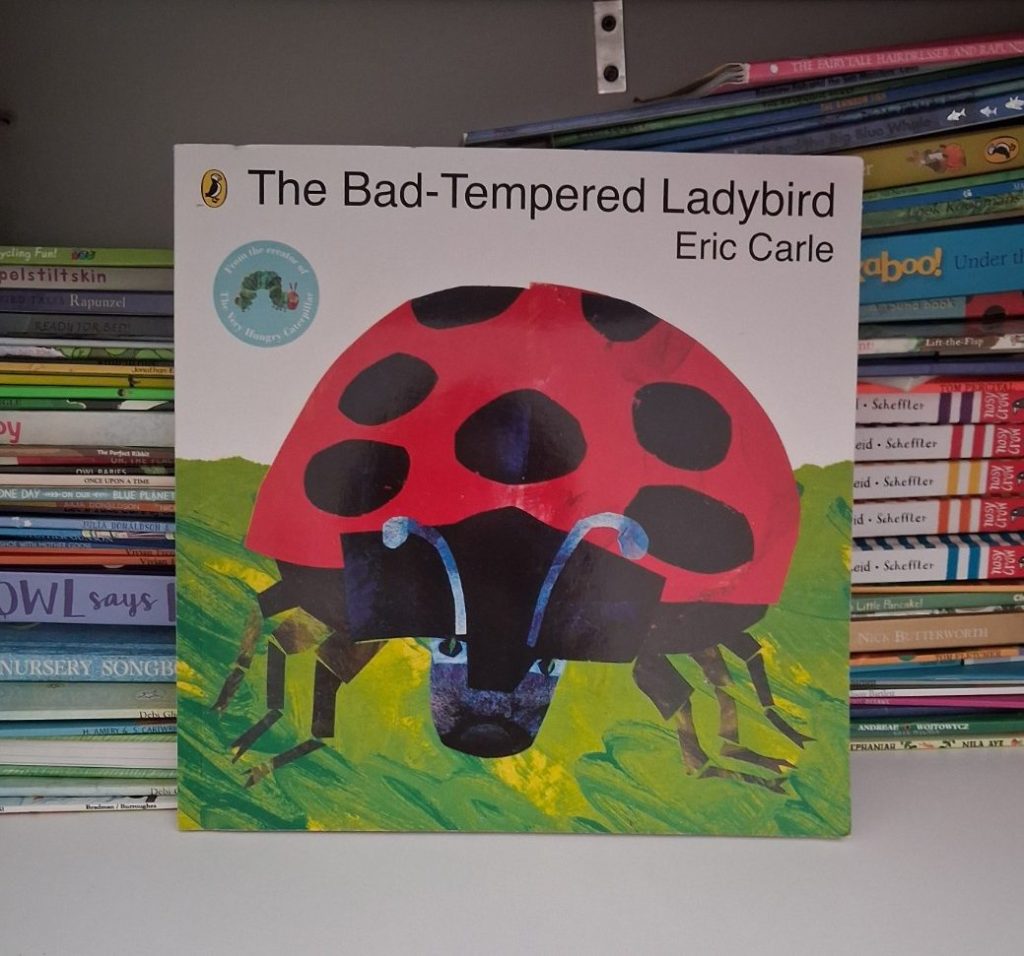
The Bad-Tempered Ladybird by Eric Carle offers far more than a story about an irritable insect. Its repeated structure, changing times, growing sequence of animals and themes of sharing and kindness create natural opportunities for literacy, mathematics, science, geography, computing and PSHE. It could support a single lesson or develop into several days of connected learning for children in Reception and Key Stage 1.
Why This Book Works
The repeated language encourages children to join in and anticipate what comes next. Each encounter follows a familiar pattern, whilst the animals gradually increase in size and the clock moves through the day.
This gives the story a clear structure and pace, while opening up meaningful discussion about time, comparison, animal features, behaviour and relationships.
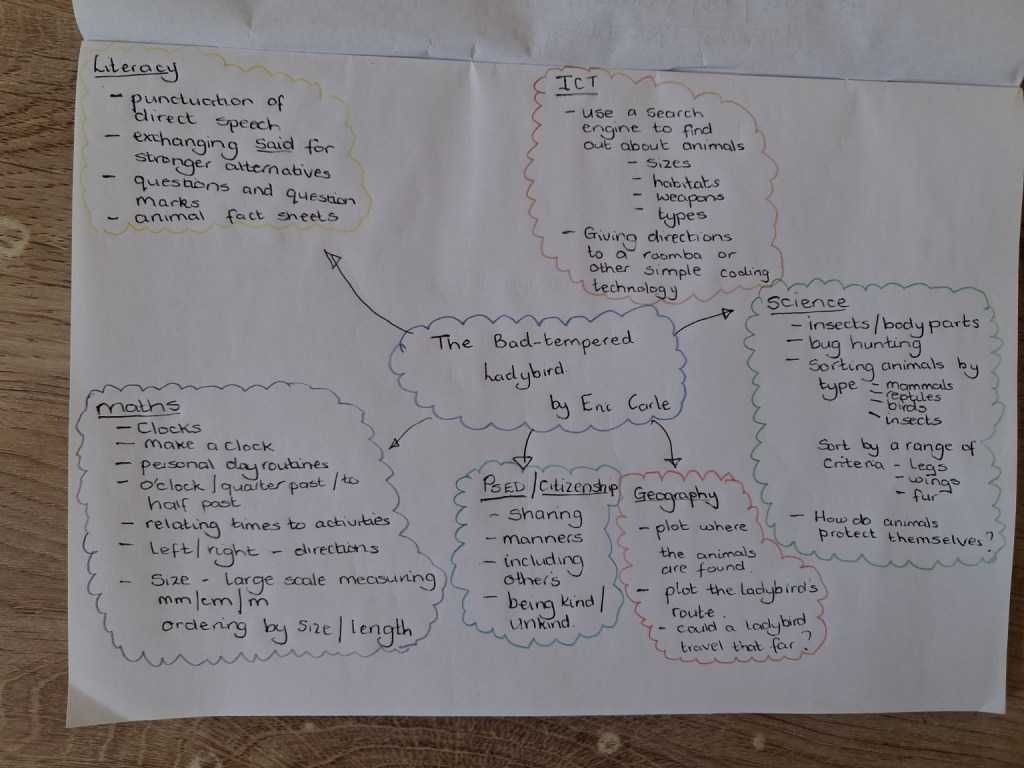
The Topic Web
Literacy Ideas
- Read the story together and encourage children to join in with the repeated phrases.
- Retell the story using pictures, puppets or a simple story map.
- Explore direct speech and identify what each character says.
- Practise using speech marks with older children.
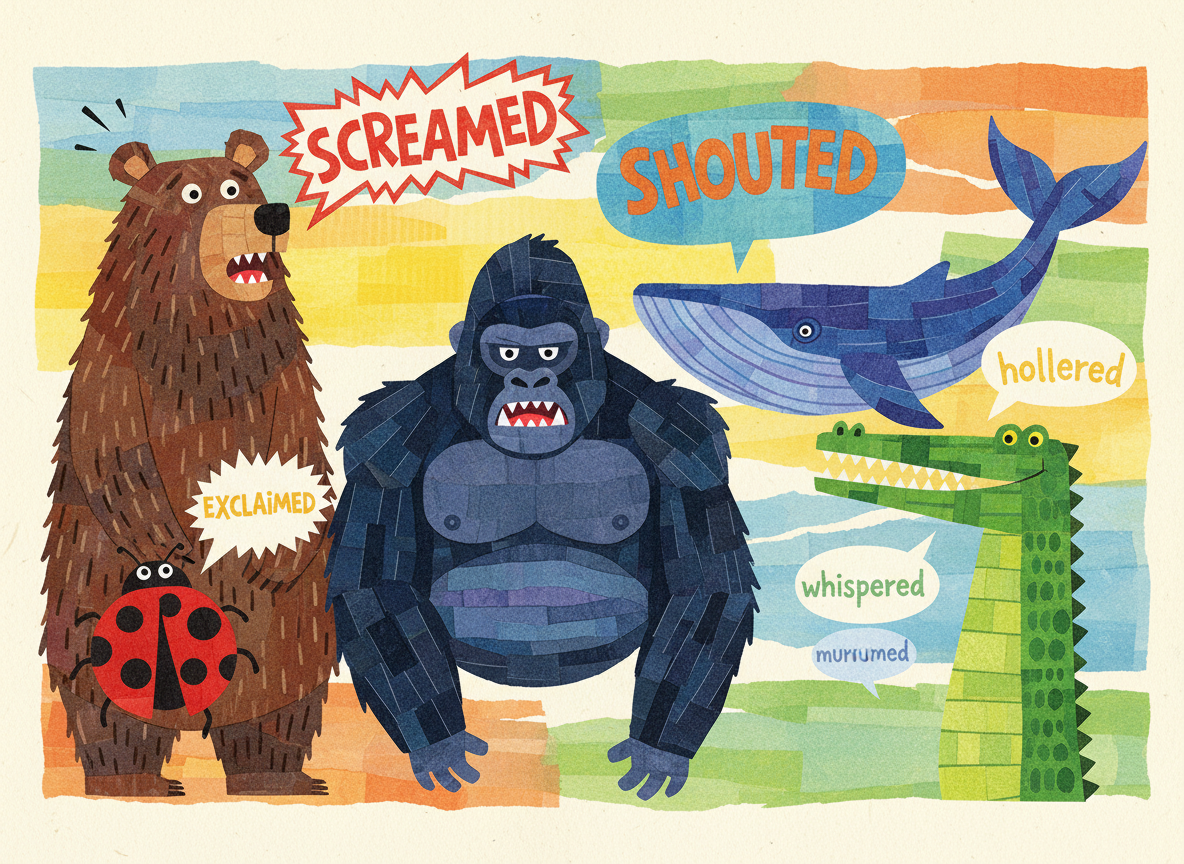
- Replace the word said with stronger alternatives such as asked, shouted, snapped or replied.
- Write questions that the ladybird could ask each animal.
- Create an animal fact file using headings, labels and simple sentences.
- Write the story from the point of view of another animal.
Maths Ideas
- Explore the clock times shown throughout the story.
- Make simple clocks and match each time to the correct event.
- Sequence the ladybird’s day from morning to evening.
- Relate times to familiar daily routines.
- Order the animals by size or length.
- Compare animals using language such as larger, smaller, longer, shorter, heavier and lighter.
- Use ladybird spots to explore counting, number bonds and simple number sentences.
- Give and follow directions using words such as left, right, forwards and backwards.
Science Ideas
- Identify the main body parts of a ladybird and other insects.
- Explore the difference between insects, mammals, birds, reptiles and other animal groups.
- Sort animals according to features such as legs, wings, fur, feathers or scales.
- Go on a bug hunt and record what you find.
- Investigate where different animals live and what they need to survive.
- Explore how animals protect themselves.
- Compare the sizes, habitats and features of the animals in the story.
- Create simple classification keys using questions such as ‘Does it have wings?’
Geography Ideas
- Find out where the animals in the story are usually found.
- Locate some of these habitats on a map or globe.
- Plot the ladybird’s journey through the story.
- Discuss whether a real ladybird could travel the same distance.
- Compare different habitats such as oceans, forests, grasslands and gardens.
- Create a simple map showing the ladybird’s route.
Computing Ideas
- Use a child-safe search engine to research one of the animals in the story.
- Find information about an animal’s size, habitat, diet and features.
- Give directions to move a toy ladybird around a simple route.
- Create a floor grid and programme a robot or programmable toy to follow the ladybird’s journey.
- Sequence instructions using words such as forwards, turn, stop and repeat.
- Create a simple digital animal fact file or presentation.
PSHE and Citizenship Ideas
- Discuss why the ladybird behaves as it does.
- Explore the difference between assertive behaviour and unkind behaviour.
- Talk about sharing, manners and taking turns.
- Identify kind and unkind choices made in the story.
- Discuss how the other animals might have felt.
- Role-play more respectful ways the ladybird could speak to others.
- Create a class list of helpful phrases such as please, thank you, may I? and you’re welcome.
- Explore what it means to include others.
Expressive Arts and Design Ideas
- Create ladybirds and other animals using tissue-paper collage.
- Look at illustrations from other Eric Carle books and compare the techniques used.
- Paint or print textured papers before cutting and layering them.
- Make animal masks or puppets for retelling the story.
- Use movement and music to represent animals of different sizes.
- Create a class mural showing the ladybird’s journey.
Grab-and-Go Supply Lesson
Create a Kinder Version of the Story
Read The Bad-Tempered Ladybird together and discuss how the ladybird speaks to the other animals.
Choose one encounter from the story and ask children to rewrite or role-play it using kinder, more respectful language.
Children could draw the two animals and add speech bubbles showing what they might say.
Older children could write a short conversation using speech marks and alternatives to said.
Finish by sharing a few examples and discussing how changing the words changes the way the characters feel.
Resources: The book, paper and pencils.
Suitable for: Reception to Year 2, with the writing adapted to the age and confidence of the children.
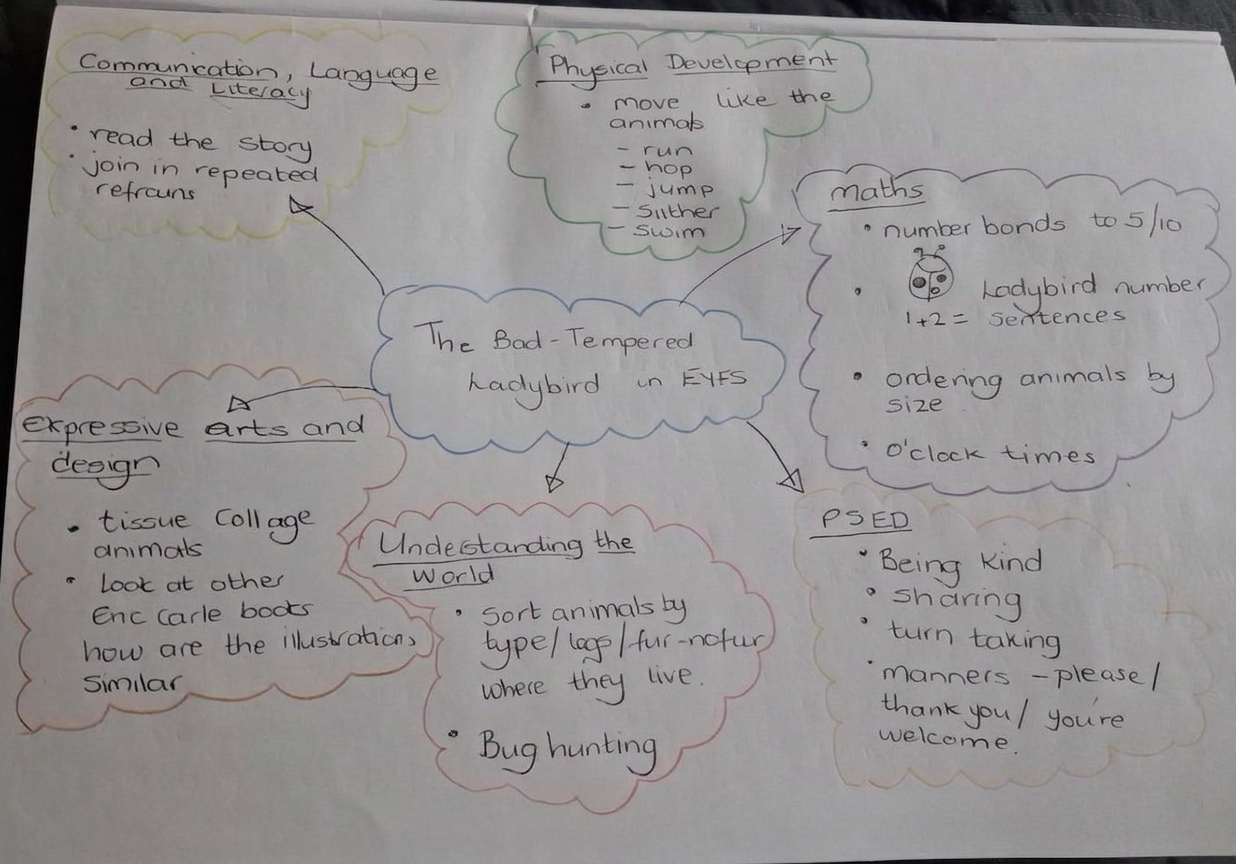
The Bad-Tempered Ladybird in EYFS
Early Years Planning Links
Within EYFS, the book offers opportunities for both adult-led teaching and open-ended provision.
Communication and Language
Join in with repeated phrases, retell the story, describe the animals and discuss feelings and behaviour.
Literacy
Sequence events, explore repeated language, create speech bubbles and make simple animal fact books.
Mathematics
Count ladybird spots, explore number bonds, order animals by size and introduce o’clock times.
Understanding the World
Sort animals by their features, investigate habitats and go on a bug hunt.
Physical Development
Move like the animals by running, hopping, jumping, slithering and swimming.
Expressive Arts and Design
Create collage insects, explore Eric Carle’s illustration style and use masks or puppets in role play.
Personal, Social and Emotional Development
Explore kindness, sharing, turn-taking, manners and the effect our words have on others.
Take It Further
Turn the story into a week-long topic built around time, animals and relationships.
Create a class animal encyclopaedia using the creatures featured in the book.
Set up a bug investigation area with magnifiers, identification cards and natural materials.
Compare The Bad-Tempered Ladybird with other Eric Carle books.
Explore other stories about kindness, sharing or difficult feelings.
Create a large floor map of the ladybird’s journey and use it for movement or coding activities.
Make a class clock display showing each stage of the story.
Invite children to design a new animal encounter for the ladybird.
Finish with a performance, puppet show or class retelling.
Final thoughts
The Bad-Tempered Ladybird combines a memorable repeated story with rich opportunities for learning about time, animals, language and relationships.
It can be used for one focused lesson or expanded into several days of connected learning. As always, the ideas are a starting point: choose the parts that suit your children, their interests and the time available.
Sometimes the richest learning begins when we look beyond the final page.


Leave a comment