About the book
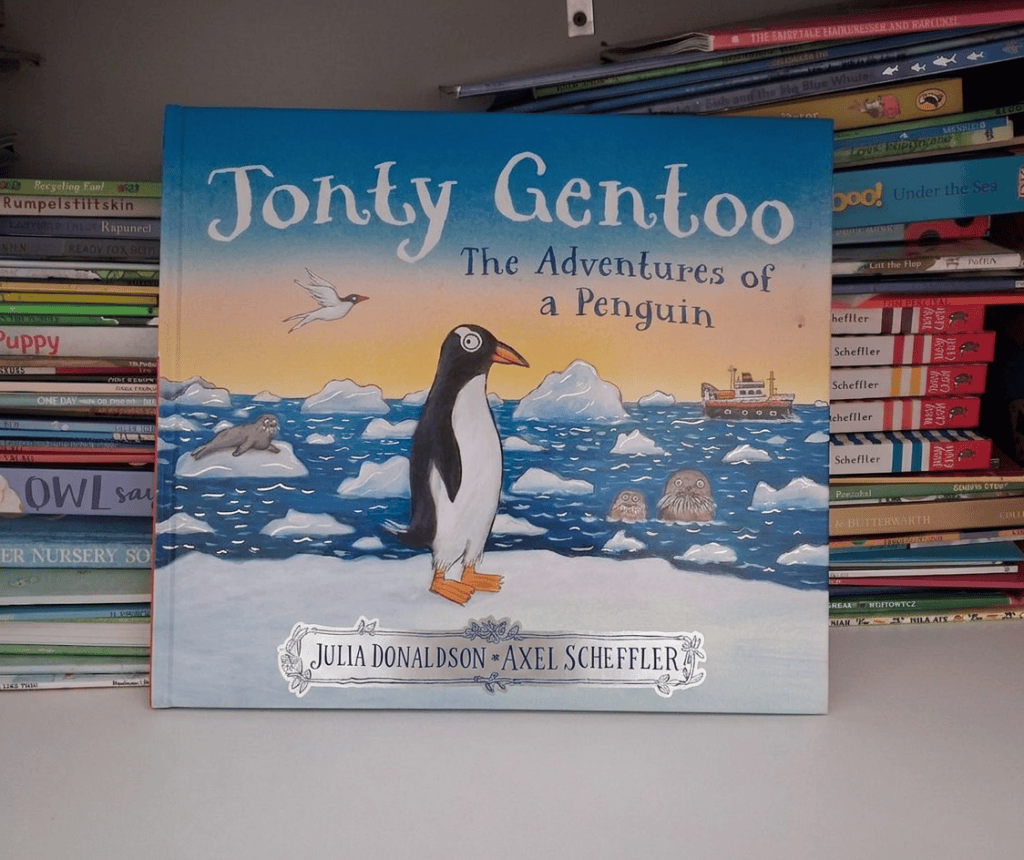
Jonty Gentoo: The Adventures of a Penguin follows Julia Donaldson’s familiar rhythmic and rhyming style, which children may recognise from books such as The Gruffalo and Room on the Broom.
The story introduces Jonty Gentoo, a young penguin who has grown bored with his rather predictable life at the zoo, where he lives with his aunts. They tell him of a faraway place where the sun shines throughout the night and day, and where “thousands of penguins slither and stroll … around the South Pole.” We join Jonty as he sets off on an adventure to find this fabled place for himself.
Why this book works
With its familiar rhyming structure, this book engages children while encouraging them to explore the wider world and compare contrasting habitats. It works particularly well alongside Handa’s Surprise, allowing children to identify similarities and differences between the warm Kenyan setting and Jonty’s icy polar environment.
The story also introduces ideas about the globe, animal migration and the role of zoos, including both their positive purposes and some of the more challenging questions surrounding animals living in captivity.
It offers a rich range of learning opportunities across the Key Stage 1 curriculum, while also providing meaningful starting points for exploration and play in the Early Years.
Curriculum web – Key Stage 1
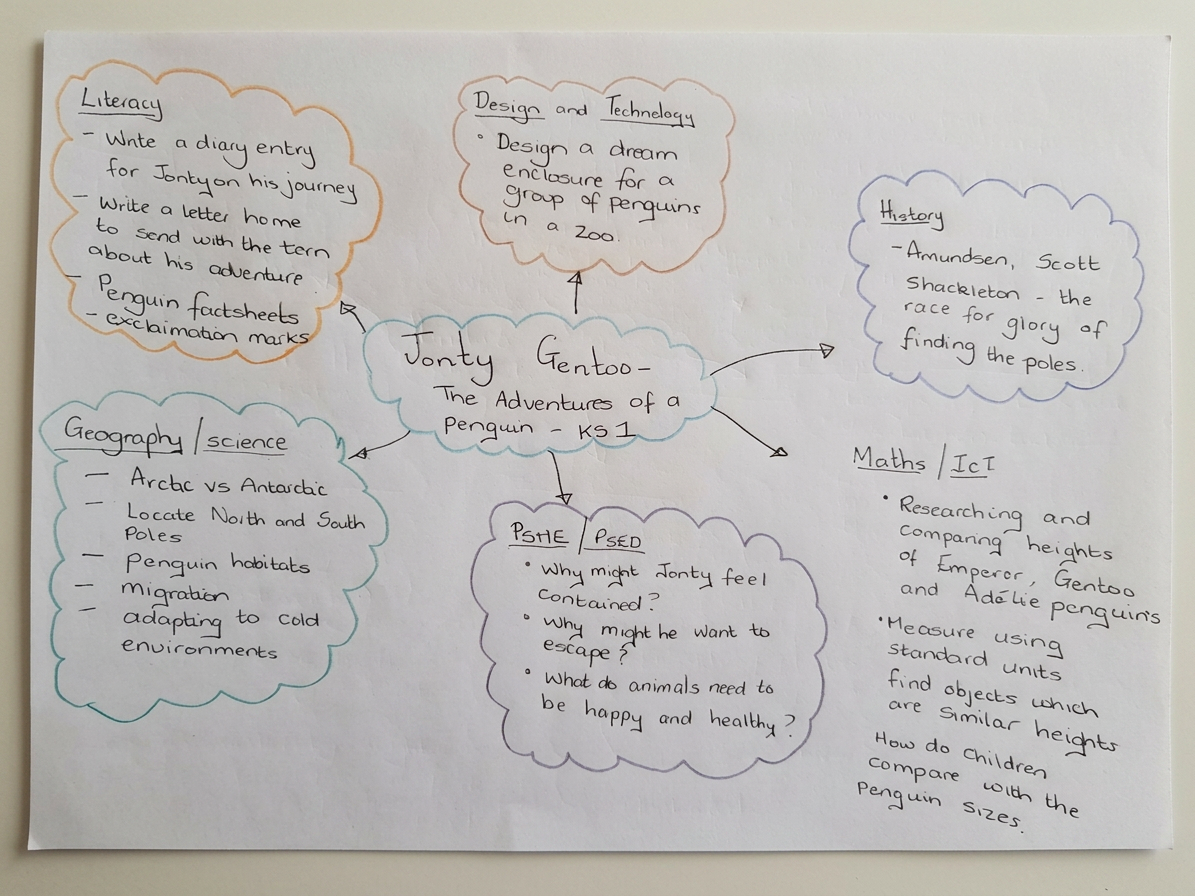
Learning Ideas for KS1
English and Literacy
- Discuss why Jonty wants to leave the zoo.
- Sequence his journey.
- Explore exclamation marks.
- Write a diary entry from Jonty’s point of view.
- Write a letter from Jonty describing his adventure.
- Create penguin fact files.
Science
- Explore penguin habitats and adaptations.
- Investigate how penguins survive cold conditions.
- Consider migration and animal needs.
- Compare animals adapted to hot and cold habitats.
Geography
- Locate the Arctic, Antarctic, North Pole and South Pole.
- Compare the Arctic and Antarctic.
- Explore oceans and polar environments.
- Contrast Jonty’s habitat with the setting of Handa’s Surprise.
Mathematics and Computing
- Research the heights of emperor, gentoo and Adélie penguins.
- Measure and mark their heights using standard units.
- Order the penguins from shortest to tallest.
- Compare their heights with children and familiar classroom objects.
Design and Technology
- Design a suitable enclosure for a group of penguins.
- Consider water, shelter, space, safety and natural behaviour.
- Build a model and explain the design choices.
History
- Explore Amundsen and Scott and the race to the South Pole.
- Extend learning through Shackleton’s Antarctic expeditions.
PSHE and Citizenship
- Why might Jonty feel confined?
- What do animals need to be happy and healthy?
- What makes a good zoo enclosure?
- Can zoos ever help animals?
- How do the tern and polar bear help Jonty?
Art and Design
- Create bubble-painted ocean scenes.
- Make collage jellyfish, fish or icy landscapes.
- Explore cold colours, patterns and texture.
Grab-and-Go Lesson
How Tall Is a Penguin?
Children predict, research and compare the heights of emperor, gentoo and Adélie penguins. They measure each height using a tape measure or metre stick, mark it on a wall or create life-size outlines, then compare the penguins with themselves and familiar classroom objects.
This could include:
- estimating;
- measuring in centimetres;
- ordering by height;
- using comparative language;
- recording findings in a simple table.
What you will need:
- pencils
- access to the web/ fact books about penguins
- rulers, metre sticks, tape measures
- chalk
- large paper or a wall
Plenary
Which penguin breed is the tallest, shortest?
Arrange the class physically by height.
Taking It Further
- Compare Jonty Gentoo with Handa’s Surprise and explore contrasting habitats.
- Research more penguin species.
- Investigate the midnight sun and polar night.
- Learn about Antarctic explorers -how did they travel? did they make it? What difficulties did they face? – (Amundsen/ Scott/Shackleton)
- Debate the role of zoos.
- Explore conservation and endangered animals.
- Compare adaptations to extreme heat and extreme cold.
EYFS Links
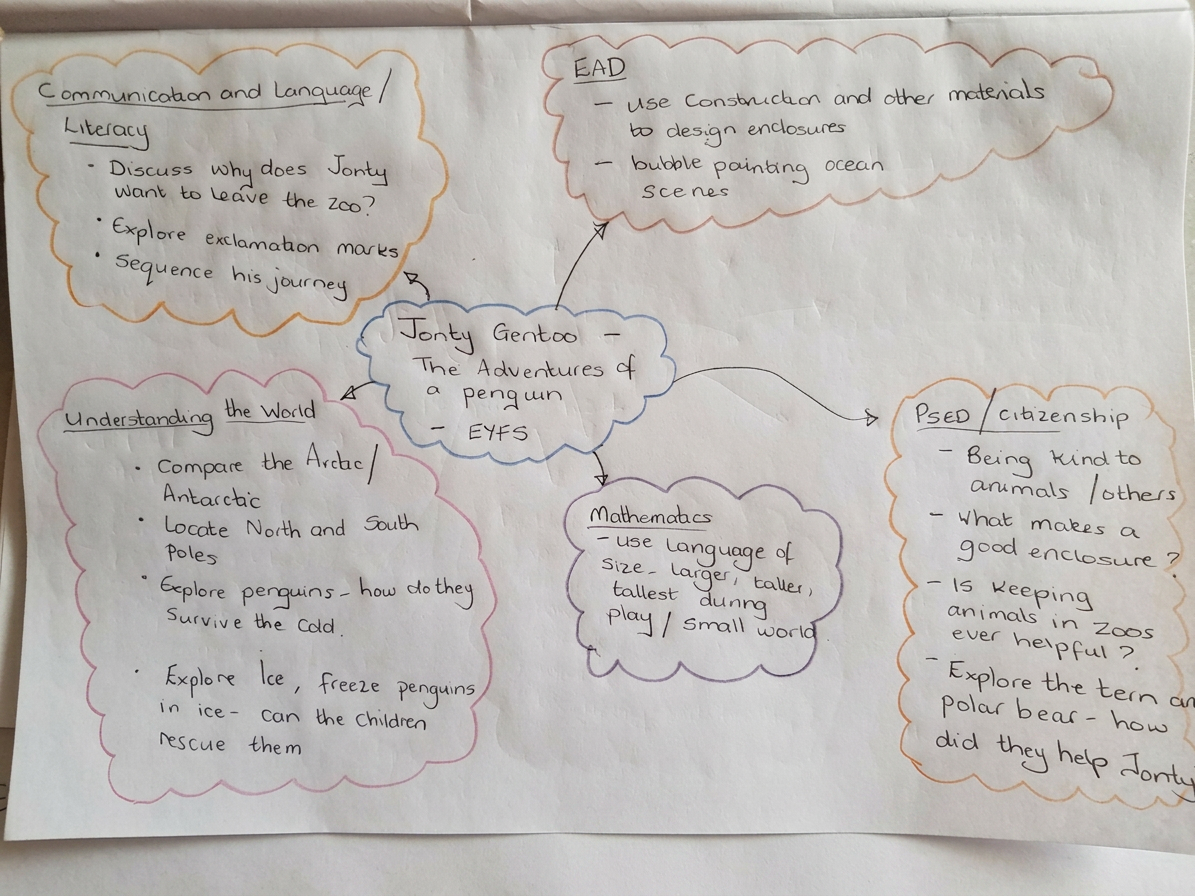
Communication and Language
- Discuss why Jonty wants to leave the zoo.
- Talk about his feelings throughout the story.
- Sequence and retell his journey.
- Explore how the other animals help him.
Literacy
- Predict the story from the cover.
- Join in with rhyme and repeated language.
- Retell the story using puppets or small-world figures.
- Make signs and labels for a zoo or penguin enclosure.
Understanding the World
- Compare the Arctic and Antarctic.
- Locate the North and South Poles using a globe.
- Explore where penguins live and how they survive the cold.
- Freeze animal figures in ice and investigate how to rescue them.
- Observe ice melting and changing.
Mathematics
- Use mathematical language naturally during enclosure building and small-world play.
- Compare animals, ice and structures using words such as bigger, smaller, taller, shorter, wider and tallest.
- Explore positional language including inside, beside, underneath and on top.
PSED
- Explore how Jonty might feel in his enclosure.
- Discuss kindness and helping others.
- Think about what animals need.
- Talk about what helps us feel safe, happy and included.
Expressive Arts and Design
- Design and build enclosures.
- Create bubble-painted ocean scenes.
- Make collage jellyfish and polar animals.
- Use moulding materials and penguin cutters.
- Move to music in a penguin parade.
Continuous Provision Ideas
Small world: Create a zoo, ocean or Antarctic landscape with penguins, ice, water and construction materials.
Construction: Invite children to build or improve Jonty’s enclosure.
Sensory play: Freeze penguins or other animals in ice and provide tools and warm water for investigation.
Creative area: Offer bubble painting, collage materials, cold-coloured paints and penguin templates.
Playdough or modelling: Add penguin cutters, loose parts and materials for making icy habitats.
Writing area: Provide postcards, maps, signs, tickets and simple fact-file templates.
Investigation area: Include ice, magnifiers, timers, containers and different materials for exploring melting.
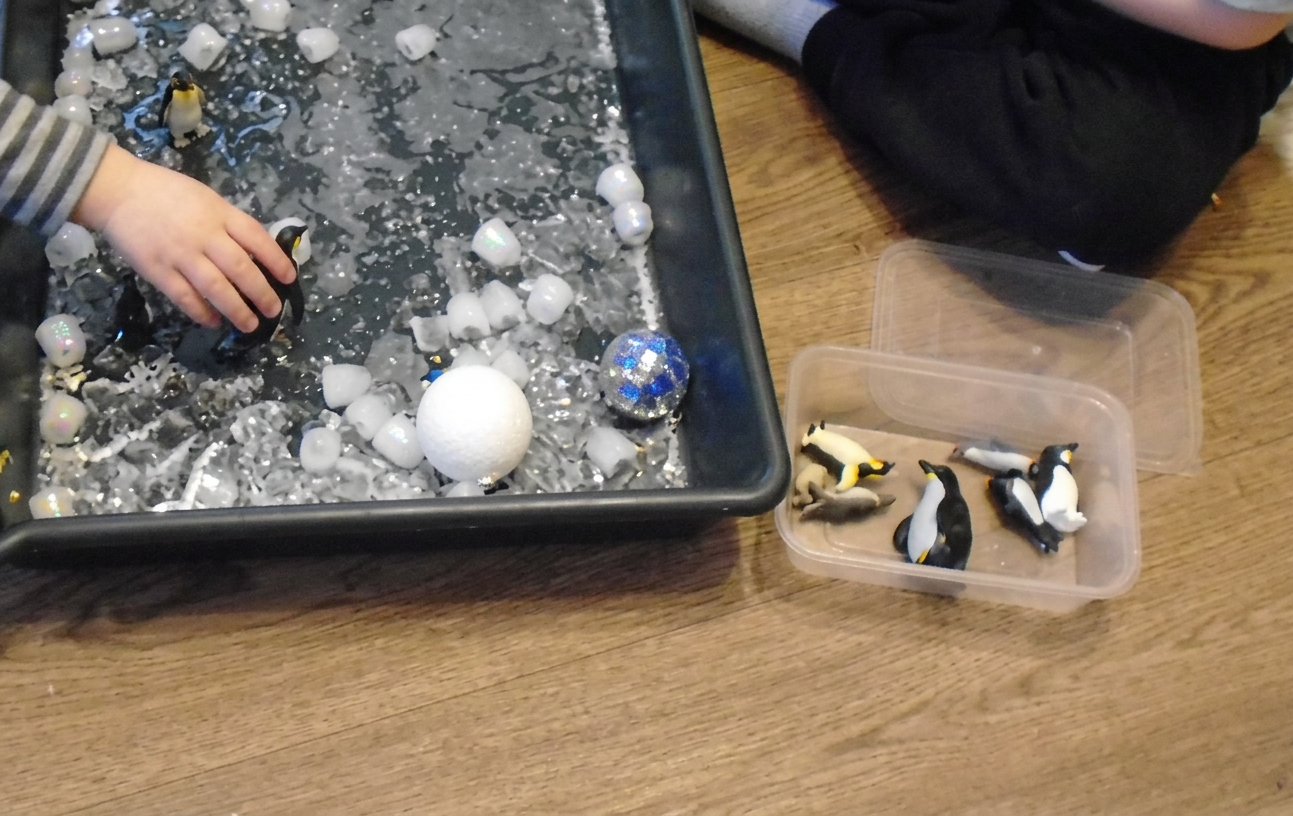
sensory play
Children explore glitter, ice and shaving foam with small world penguins.
Claire’s Final Thoughts…
We explored Jonty Gentoo as part of a two-week theme around Arctic and polar animals. The story provided a natural starting point for learning about penguins, icy habitats and the differences between the Arctic and Antarctic, while also opening up conversations about belonging, kindness and what animals need in order to thrive.
The children were particularly engaged by the sensory and investigative experiences. Frozen animals in ice encouraged sustained exploration as they worked out how to rescue them and observed the ice changing as it melted. The ice and loose-parts trays held their attention for long periods, giving plenty of opportunities for talk, problem-solving and the natural use of mathematical language such as bigger, smaller, taller, more and less.
Creative activities included bubble-painted ocean scenes, cotton-wool seals, Arctic animal collage and modelling with dough. The children also enjoyed using penguin cutters, taking part in a penguin parade and exploring the story through music and movement. Construction materials gave them opportunities to create enclosures and habitats, while thinking about space, shelter and the needs of the animals living there.
What worked particularly well was the way the learning grew directly from the story. Rather than trying to force every area of the curriculum into the theme, the children’s interests led naturally into sensory exploration, creative work, small-world play and thoughtful discussion. Jonty Gentoo offered a gentle but meaningful way to introduce contrasting habitats and to encourage children to think more deeply about where animals belong, how we care for them and how kindness can help someone on their journey.
Using an electric ice maker helped keep a constant supply of ice for exploration and, in our Montessori environment gave children opportunities for independence by replenishing the ice activities and using technology.
Jonty Gentoo shows how one small penguin’s journey can inspire children to explore habitats, investigate the wider world and consider where living things truly belong—continuing the learning beyond the final page.


Leave a comment