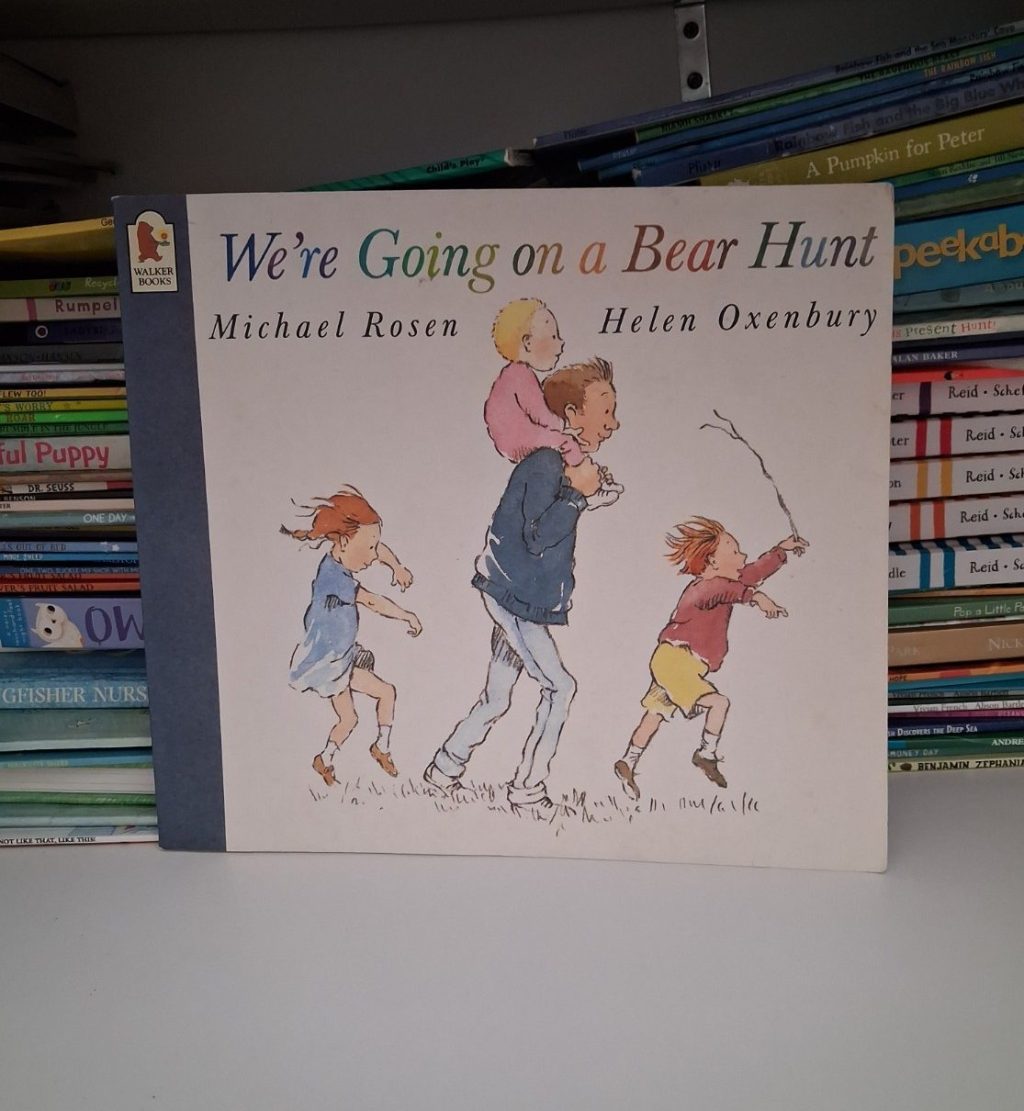
We’re Going on a Bear Hunt is one of those books that seems to become part of childhood. Its repeated refrain, wonderfully expressive sound words and sense of adventure invite children to join in almost immediately. The story moves through a series of contrasting environments, from swishy grass and a deep cold river to thick mud, a snowstorm and finally a dark cave.
It is a story that naturally encourages movement, language, imagination and participation, making it particularly rich for both Early Years and Key Stage 1.
Why this book works
The repetitive structure gives children confidence to join in and anticipate what comes next, while the rhythmic language makes the story memorable and enjoyable to retell. Words such as swishy swashy, splash splosh and squelch squerch offer opportunities to explore sound, rhythm and descriptive language in a way that feels playful rather than forced.
The journey itself provides a natural framework for learning. Children can explore different environments and habitats, investigate materials such as water, mud and ice, use positional language as they travel over, under and through, and recreate the story through movement, drama, music and art.
There is also a quieter emotional thread within the story. The excitement of the hunt turns to fear when the family finally meets the bear, but the ending leaves plenty to wonder about. Why does the bear follow them? Is he frightening, or might he simply be lonely? These questions can open up thoughtful conversations about feelings, assumptions and seeing a situation from another point of view.
My thought process
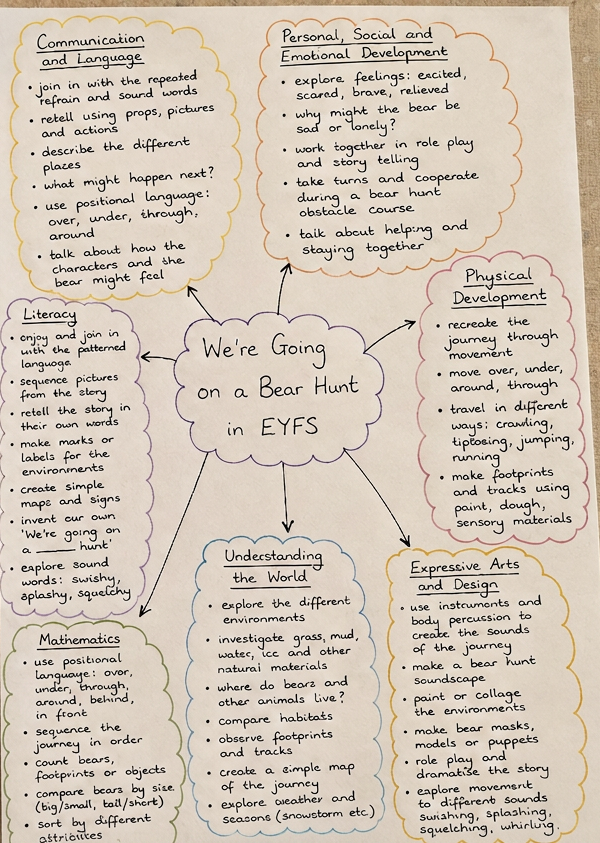
When I begin planning from a picture book, I rarely start with a finished lesson plan. I usually begin with a rough handwritten brainstorm, jotting down the learning possibilities that immediately occur to me and allowing one idea to lead naturally into another. Many of these ideas come directly from experiences I have seen work well before, or from discussions with children and the interests they have shown in my setting.
For We’re Going on a Bear Hunt, the repeated language quickly suggested literacy and communication activities, while the journey opened up links to geography, habitats, positional language, movement and sensory exploration. From that initial page of notes, I can then begin to organise the ideas into EYFS areas of learning and Key Stage 1 curriculum subjects.
For We’re Going on a Bear Hunt, the repeated language quickly suggested literacy and communication activities, while the journey opened up links to geography, habitats, positional language, movement and sensory exploration. From that initial page of notes, I can then organise the ideas into EYFS areas of learning and Key Stage 1 curriculum subjects.
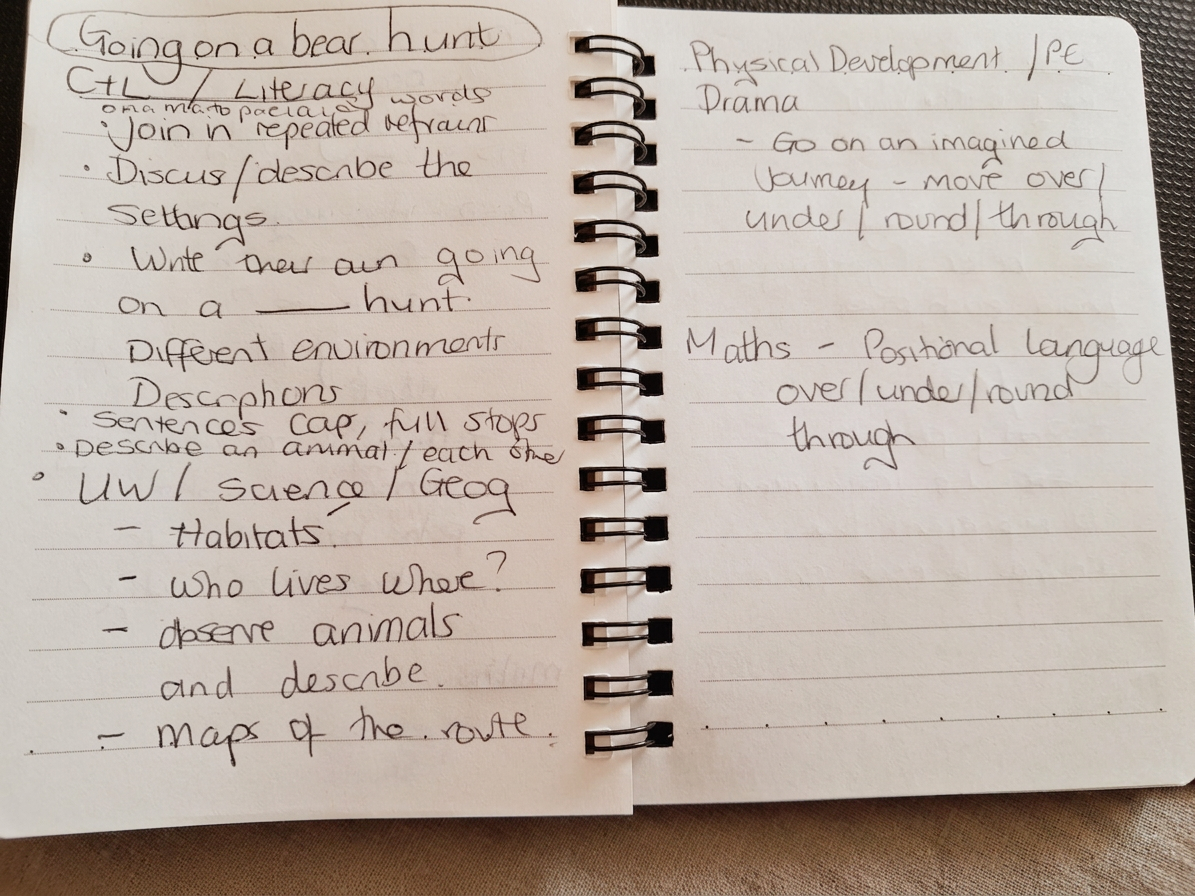
an example of my rough initial notes
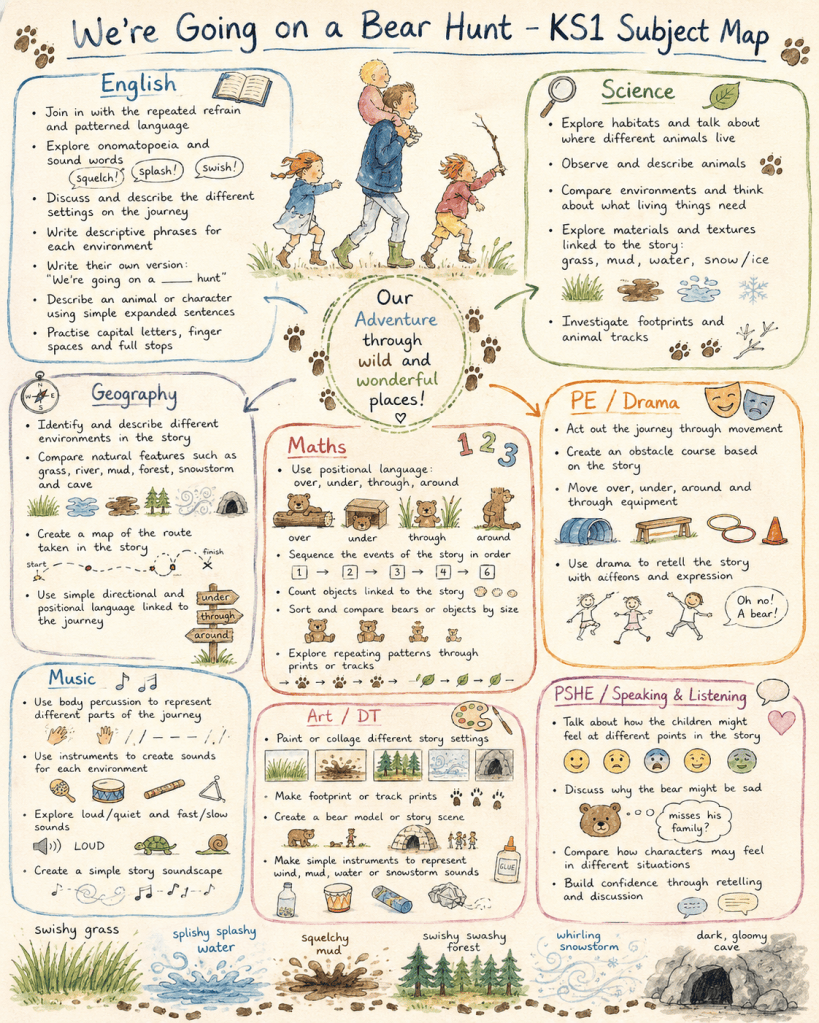
Key Stage 1
We’re Going on a Bear Hunt offers lots of opportunities to make links across the curriculum. The journey structure makes it particularly useful for geography, science, movement and language, while the repetitive text gives children a familiar framework for speaking, reading and writing.
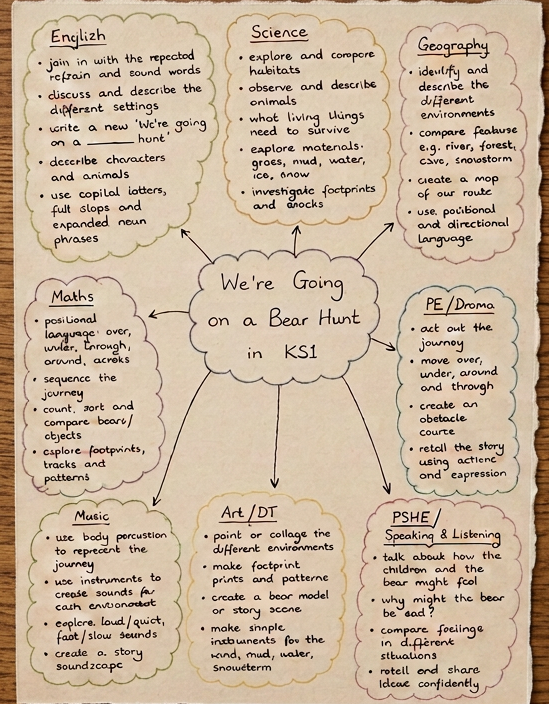
English
- Join in with and discuss the repeated refrain and patterned language.
- Explore onomatopoeia and the effect of sound words such as swishy swashy and squelch squerch.
- Describe the different settings using adjectives and expanded noun phrases.
- Retell the story in sequence.
- Write a new version of the story, such as We’re Going on a Dinosaur Hunt or We’re Going on a Minibeast Hunt.
- Describe an animal or character using simple sentences with accurate punctuation.
Science
- Explore different habitats and discuss which animals might live in them.
- Observe and describe animals.
- Think about what living things need to survive.
- Compare natural materials linked to the story, such as grass, mud, water and ice.
- Investigate footprints and animal tracks.
Geography
- Identify and describe the different environments in the story.
- Compare features such as the river, forest, grassland, mud and cave.
- Create a simple map showing the family’s route.
- Introduce simple map symbols and keys.
- Use directional and positional language to describe a route.
Mathematics
- Explore positional language such as over, under, through, around, behind and in front of.
- Sequence the stages of the journey.
- Count, sort and compare bears or other story-related objects.
- Compare size and order objects from smallest to largest.
- Create repeating patterns using footprints or tracks.
PE and Drama
- Recreate the journey through movement.
- Explore different ways of travelling through the imagined environments.
- Move over, under, around and through equipment.
- Retell the story through drama and actions.
- Create a Bear Hunt obstacle course.
Music
- Use body percussion to represent different parts of the journey.
- Choose instruments to represent grass, water, mud, wind and snow.
- Explore loud and quiet, fast and slow sounds.
- Create a simple soundscape to accompany the story.
Art and Design
- Paint or collage the contrasting story environments.
- Explore footprint and track printing.
- Create a bear model or small-world scene.
- Experiment with different materials and textures to represent the journey.
PSHE / Speaking and Listening
- Compare how the same event can feel different from another character’s point of view.
- Discuss how the children might feel at different points in the story.
- Explore feelings such as excitement, bravery, worry, fear and relief.
- Consider why the bear might follow the family.
- Discuss whether the bear may be lonely rather than frightening.
Grab and Go Lesson: Map the Bear Hunt
Curriculum links: Geography, English, Maths
Age: KS1
Time: Around 30–45 minutes
Learning objective
To sequence a journey and use simple positional and directional language.
You will need
- We’re Going on a Bear Hunt
- Large paper or whiteboard
- Pens or pencils
- Optional: simple picture cards for the grass, river, mud, forest, snowstorm and cave
Start
Revisit the journey in the story and ask the children to remember the places the family travels through.
As each setting is named, place or draw it in sequence:
grass → river → mud → forest → snowstorm → cave
Talk about how the family travels through each part of the journey and introduce or revisit words such as over, under, through, around, past, beside.
Main activity
Create a simple class map of the Bear Hunt journey.
Model drawing a route from the family’s home to the cave, adding the different environments along the way.
Children then create their own version of the map, either:
- copying the journey from the story, or
- designing their own Bear Hunt route.
Encourage them to add simple labels, arrows and symbols.
Challenge
Ask children to describe their route to a partner without pointing.
For example:
“Go through the long grass, across the river and around the trees.”
Their partner can try to follow the instructions on the map.
Support
Provide picture cards that children can place in the correct sequence before drawing.
Adults can model sentence stems such as:
- First we go…
- Next we travel…
- Then we go through…
- Finally we reach…
Taking it further
Children could add a simple map key using their own symbols for features such as trees, water, mud or a cave.
They could also swap maps and see whether another child can successfully follow the route.
Why this works
It uses the familiar story sequence to introduce early mapping skills without making the geography feel abstract. It also naturally brings together positional language, speaking and listening, sequencing and mark-making.
I think this is a particularly good Grab and Go for this book because it needs virtually no preparation beyond the book, paper and pens.
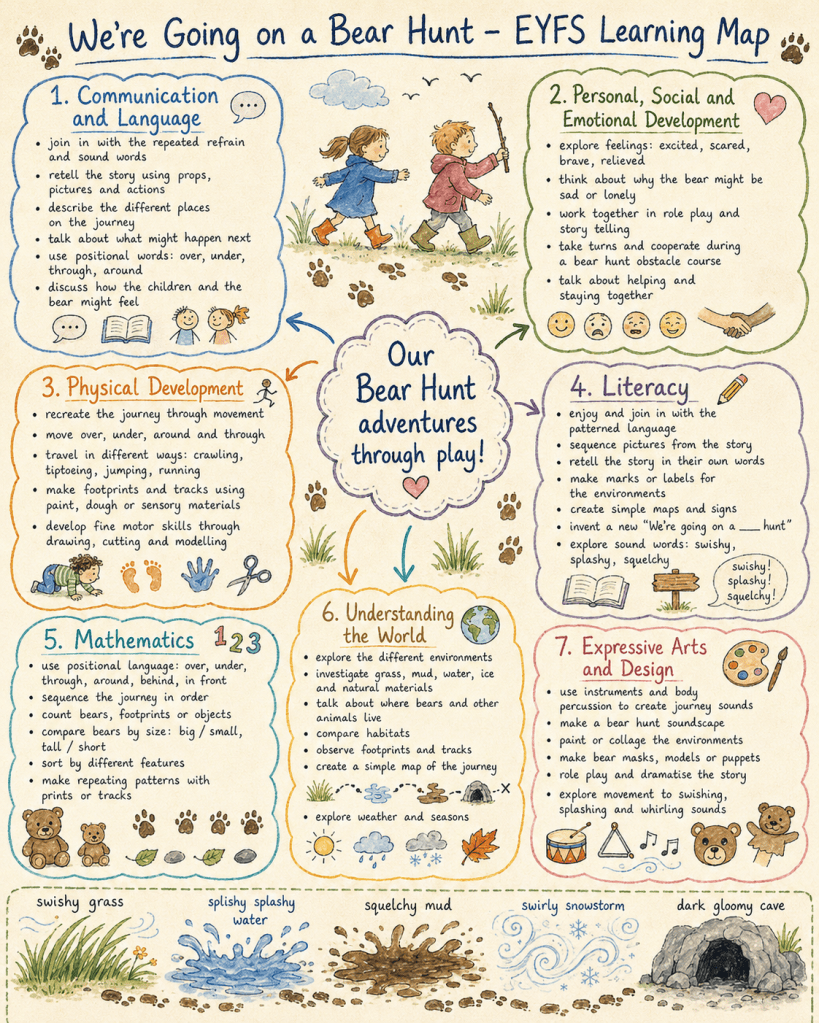
EYFS Learning Opportunities
Early Years Foundation Stage
We’re Going on a Bear Hunt is especially rich for Early Years because the story naturally invites children to join in, move, repeat, explore and imagine. The familiar refrain and sensory language make it particularly accessible for children who enjoy learning through action and play.
Communication and Language
- Join in with the repeated refrain and sound words.
- Retell the story using props, pictures or actions.
- Describe the different environments in the story.
- Talk about what might happen next.
- Introduce and use positional language such as over, under, through and around.
- Discuss how the family and the bear might be feeling.
Personal, Social and Emotional Development
- Explore feelings such as excitement, bravery, worry and fear.
- Talk about what helps us feel safe.
- Discuss why the bear might be sad or lonely.
- Consider how different characters may feel about the same event.
- Work together during role play and story retelling.
- Take turns and cooperate during movement activities.
Physical Development
- Recreate the journey through movement.
- Move over, under, around and through obstacles.
- Explore different ways of travelling, such as creeping, jumping, running and tiptoeing.
- Make large movements to represent grass, water, mud and snow.
- Create footprints and tracks using paint, dough or sensory materials.
- Develop fine motor skills through drawing, cutting, modelling and mark-making.
Literacy
- Join in with the patterned and repetitive language.
- Sequence pictures from the story.
- Retell the story in their own words.
- Explore the sound words in the text.
- Add labels or marks to simple story maps.
- Make signs for different parts of the journey.
- Invent a new version of the story, such as “We’re going on a dinosaur hunt.”
Mathematics
- Use positional language such as over, under, through, around, behind and in front.
- Sequence the stages of the journey.
- Count bears, footprints or other story objects.
- Compare bears by size.
- Sort objects by different properties.
- Make repeating patterns using footprints or tracks.
- Explore simple routes and directions.
Understanding the World
- Explore the contrasting environments in the story.
- Investigate natural materials such as grass, mud, water and ice.
- Talk about where bears and other animals live.
- Explore the idea of habitats.
- Look at animal footprints and tracks.
- Create simple maps of the journey.
- Talk about weather and seasonal conditions linked to the story.
Expressive Arts and Design
- Use instruments and body percussion to create the sounds of the journey.
- Create a simple Bear Hunt soundscape.
- Paint or collage the different environments.
- Make bears, caves or story scenes using modelling materials.
- Use small-world resources to recreate the journey.
- Act out the story through role play.
- Explore movement inspired by swishy grass, splashing water, squelchy mud and a whirling snowstorm.
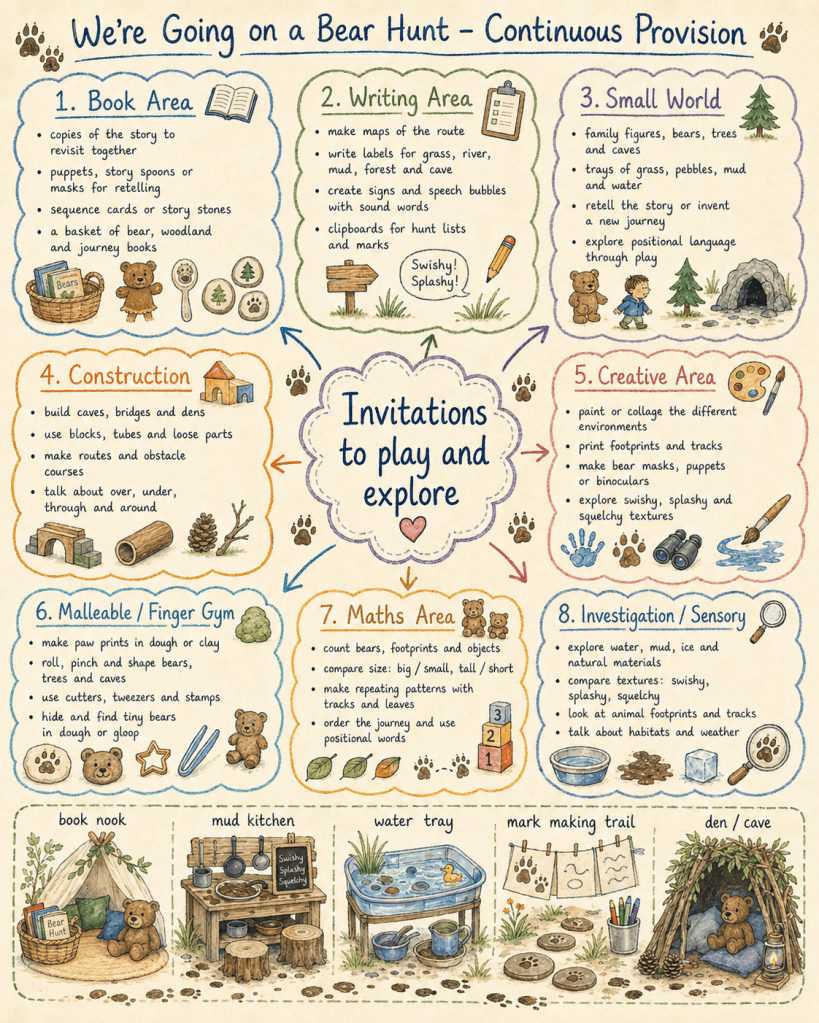
What about Continuous Provision?
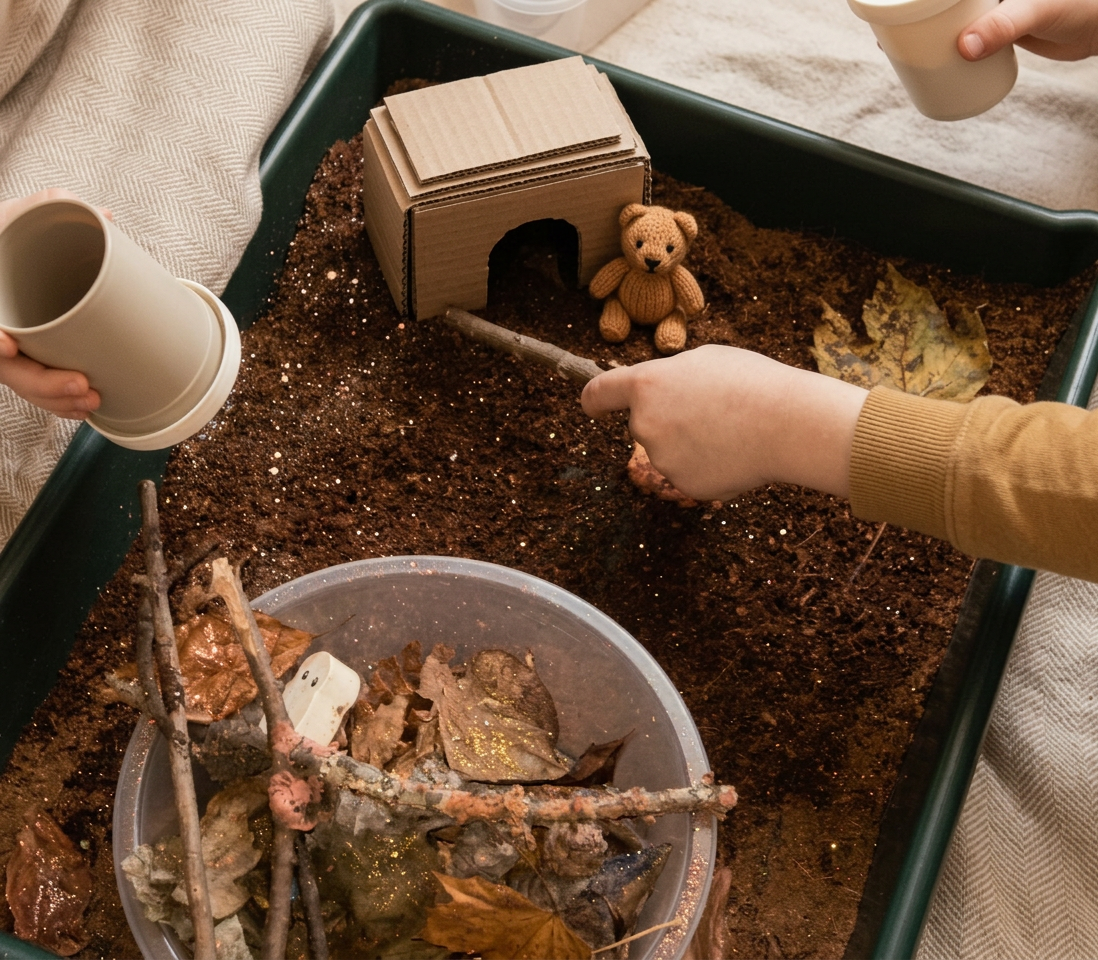
A strong book can continue to influence children’s play long after story time has finished. Rather than replacing every area of provision with a themed activity, I would add a few carefully chosen resources and invitations that allow children to revisit the story, develop their own ideas and make links through play.
Book Area
- Add copies of We’re Going on a Bear Hunt for children to revisit independently.
- Include puppets, masks, story spoons or simple props for retelling.
- Add sequencing cards or story stones.
- Include other books about bears, journeys, woodland and habitats.
Writing Area
- Provide clipboards and paper for children to make their own maps.
- Add signs and labels for grass, river, mud, forest and cave.
- Encourage children to make hunt lists, messages or directions.
- Offer sound words such as swishy, splashy and squelchy as prompts for mark making and writing.
Small World
- Provide figures, bears, trees, stones and materials that can represent the different environments.
- Allow children to recreate the familiar journey or invent a completely new one.
- Model positional language naturally during play: over, under, through, around, behind.
Construction
- Encourage children to build caves, bridges, dens and routes.
- Add tubes, blocks and loose parts for making obstacles.
- Invite children to create a journey for a bear or small-world character to follow.
- Use the finished constructions as opportunities for positional and directional language.
Creative Area
- Offer paint, collage and printing materials to represent the different settings.
- Explore footprint and track printing.
- Make simple masks, puppets or binoculars for imaginative play.
- Provide materials with contrasting textures to represent grass, water, mud or snow.
Malleable / Fine Motor
- Make bear or paw prints in dough or clay.
- Roll, pinch and shape bears, trees and caves.
- Add cutters, tweezers, stamps and loose parts.
- Hide small bears or natural objects in dough for children to find and manipulate.
Maths Area
- Add bears or footprints for counting and matching.
- Compare size using big, small, tall and short.
- Create repeating patterns with tracks, leaves or natural objects.
- Sequence pictures from the journey and explore simple positional language.
Investigation and Sensory Play
- Explore water, mud, ice, grass and other natural materials.
- Compare textures and introduce descriptive vocabulary.
- Look closely at animal tracks and footprints.
- Talk about habitats, weather and how different environments feel.
The important thing is that these do not all need to appear at once. A few well-chosen additions can be introduced in response to the children’s interests, allowing the story to become a starting point for play rather than a theme that takes over the whole provision.
Claire’s Final Thoughts
We’re Going on a Bear Hunt is one of those rare stories that seems to offer something new each time you return to it. For younger children, it is full of rhythm, repetition and movement; for older children, it opens up opportunities for richer discussion, descriptive language and creative thinking. It is a book that can be retold, acted out, mapped, painted, explored through sound and revisited again and again in play.
What I particularly like about this story is that it does not need lots of elaborate preparation to be worthwhile. A copy of the book, space to move, and a few carefully chosen enhancements to provision are often enough to spark meaningful learning. Whether children are swishing through grass in the outdoor area, making maps of the journey, or wondering whether the bear was lonely rather than scary, the story provides a rich starting point for exploration across the curriculum.
As always, the real magic comes from following the children’s interests and allowing one story to lead naturally into many different possibilities — true learning beyond the final page.


Leave a comment