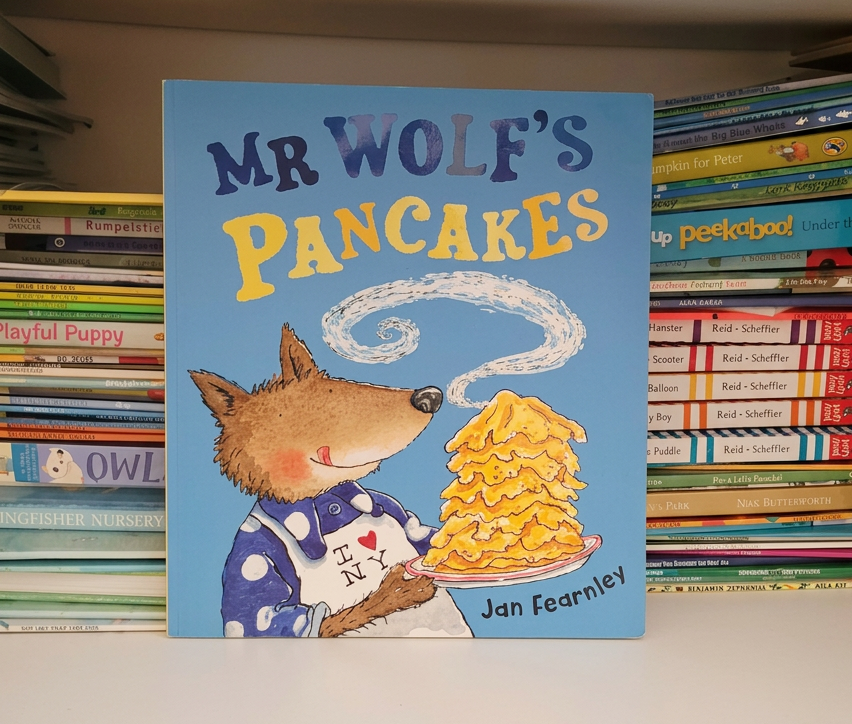
About the Book
Mr Wolf’s Pancakes by Jan Fearnley plays with the classic storybook trope of a character asking others for help and being repeatedly refused. Mr Wolf wants to make pancakes, but each of his neighbours is too busy or unwilling to help him read the recipe, write a shopping list, count his money or carry his shopping.
Determined to manage on his own, Mr Wolf completes each task himself and eventually makes a delicious stack of pancakes. When the smell attracts the very neighbours who refused to help him, the story takes a darkly comic twist that gives children plenty to talk about.
It is a familiar story pattern with an unexpected ending, making it particularly useful for exploring kindness, helping others, fairness, consequences and different points of view.
Why this book works
This book offers a wide range of cross-curricular opportunities, with learning arising naturally from the story rather than feeling added on. Mr Wolf’s pancake-making journey provides links to maths through money, counting and shopping; science through mixing, cooking and observing change; and English through recipes, lists, instructions and storytelling.
The familiar fairy-tale characters give children something they already recognise, while their rather unexpected behaviour provides plenty to discuss. Why won’t anybody help Mr Wolf? Are they being unkind? And, when they finally arrive wanting to share his pancakes, what should he do?
There are also lots of opportunities for practical learning. Children can write shopping lists, handle coins, make pancakes, investigate ingredients, design something to help Mr Wolf carry his shopping and even take part in a pancake race. It is a story that lends itself particularly well to learning through talk, investigation and first-hand experience.
Key Stage 1
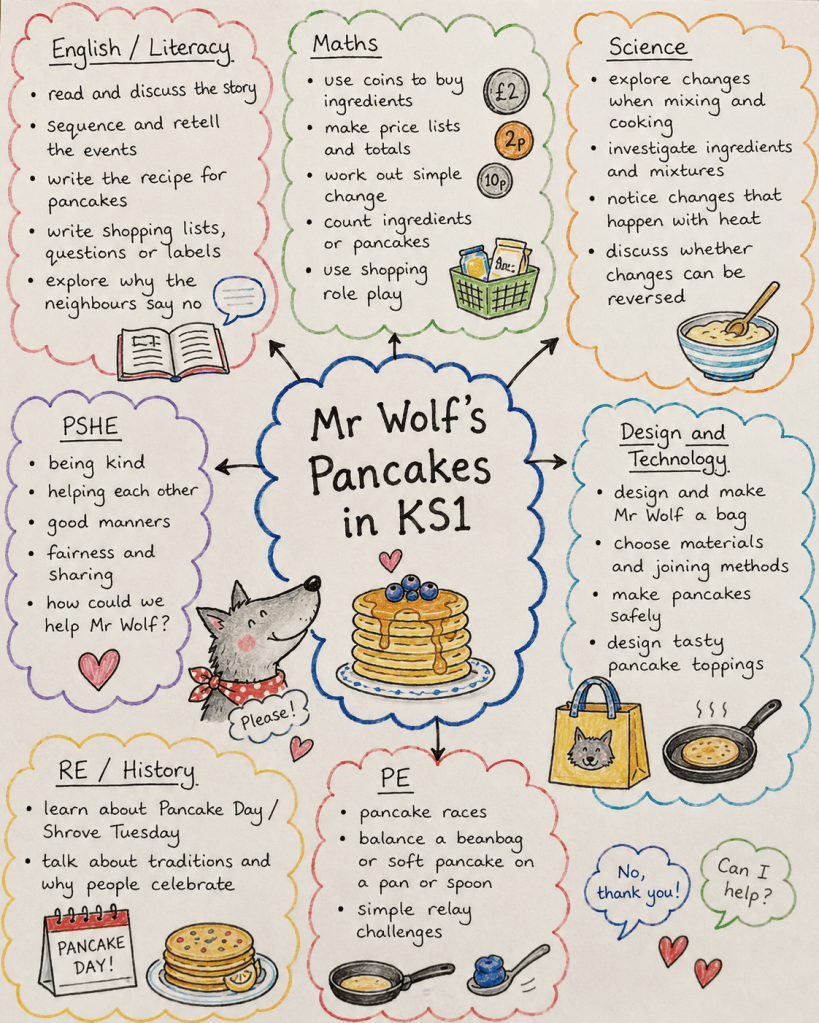
Mr Wolf’s Pancakes offers a wide range of opportunities across the Key Stage 1 curriculum. The story naturally links literacy, maths, science and design technology through the practical process of planning, shopping and cooking, while the behaviour of the characters opens up plenty of opportunities for discussion around kindness, fairness and helping others.
English / Literacy
- Read and discuss the story, focusing on the characters and their choices.
- Sequence and retell the main events.
- Write a pancake recipe using simple instructional language.
- Create shopping lists, labels or questions for the characters.
- Explore why the neighbours repeatedly refuse to help Mr Wolf.
- Rewrite or extend the ending from another character’s point of view.
Mathematics
- Use coins to buy ingredients in a simple role-play shop.
- Make price lists and calculate totals.
- Explore simple change.
- Count ingredients and pancakes.
- Compare quantities and prices.
- Use shopping role play to apply number skills in a meaningful context.
Science
- Observe what happens when ingredients are mixed together.
- Explore the difference between ingredients and mixtures.
- Notice the changes that happen when pancake batter is heated.
- Discuss whether these changes can be reversed.
- Compare ingredients before and after cooking using simple descriptive vocabulary.
Design and Technology
- Design and make a bag for Mr Wolf to carry his shopping.
- Choose suitable materials and joining methods.
- Think about what makes a bag strong enough for its purpose.
- Make pancakes safely, following a simple recipe.
- Design and evaluate pancake toppings.
PSHE
- Talk about kindness and helping other people.
- Explore good manners and polite ways of asking for help.
- Discuss fairness and sharing.
- Think about who helps us and how we can help others.
- Consider whether Mr Wolf’s final actions are fair or justified.
RE / History
- Find out about Pancake Day and Shrove Tuesday.
- Explore why pancakes are traditionally associated with this day.
- Talk about family and community traditions.
- Compare the ways people may celebrate today with traditions from the past.
PE
- Take part in pancake races using beanbags or soft pancakes, mini wraps work particularly well.
- Balance an object on a pan, tray or spoon.
- Create simple relay races.
- Develop coordination, balance and control through playful challenges.
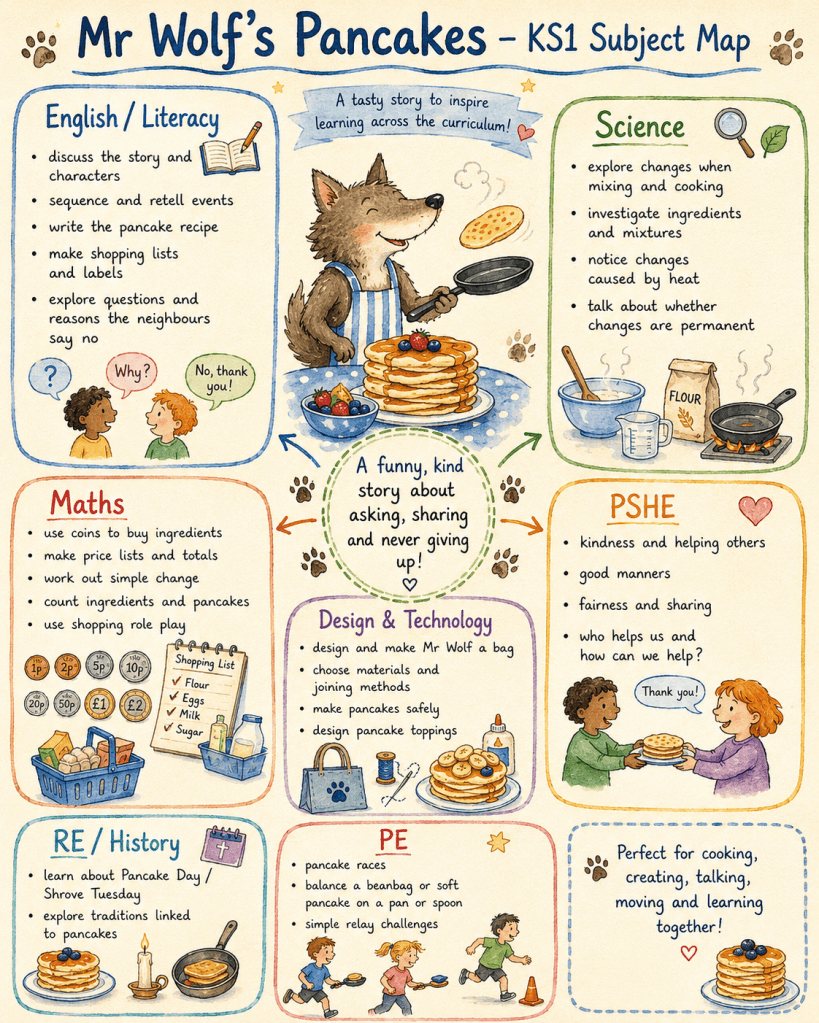
Grab and Go Lesson: Help Mr Wolf With His Shopping
Curriculum links: Maths, English, PSHE
Age: KS1
Time: 30–40 minutes
Learning objective
To use simple money skills and make choices within a budget.
You will need
- Simple pictures or labels for pancake ingredients
- Prices for each item
- Coins or pretend coins
- Paper and pencils
Start
Revisit the part of the story where Mr Wolf needs to buy his ingredients.
Ask:
- What does he need?
- How could we help him?
- What would we need to know before going shopping?
Together, make a simple shopping list.
Main activity
Create a small Mr Wolf’s Shop with ingredients priced at child-friendly amounts.
For example:
- Flour – 10p
- Milk – 20p
- Eggs – 15p
- Butter – 10p
- Lemon – 5p
Give children a budget and challenge them to buy the ingredients Mr Wolf needs.
Depending on ability, children can:
- match coins to prices
- find totals
- choose the correct coins
- calculate simple change
- work out whether they have enough money
English link
Children can write Mr Wolf’s shopping list or make a simple receipt showing what he bought.
PSHE link
Finish by returning to the story:
Mr Wolf asked lots of people to help him. How could we have helped him differently?
Taking It Further: Design a Shopping Bag for Mr Wolf
And your idea here is excellent because it links DT, maths and science very naturally.
Children could:
- Look at different shopping bags made from paper, cotton, felt or other available materials.
- Predict which material will be strongest.
- Test sample materials by gradually adding weight — 100g, 200g, 300g… — until they tear, stretch or fail.
- Record and compare results.
- Decide which material would be most suitable for Mr Wolf’s shopping.
- Give children a materials budget, with different materials and joining methods having different costs.
- Design a bag within their budget.
- Choose how to join it: glue, staples, stitching, tape etc.
- Make the bag.
- Test how much shopping it can safely carry.
- Evaluate the finished product: What worked? What would you change?
You could even finish with a wonderfully concrete challenge:
Can your bag carry all of Mr Wolf’s pancake ingredients?
EYFS Links
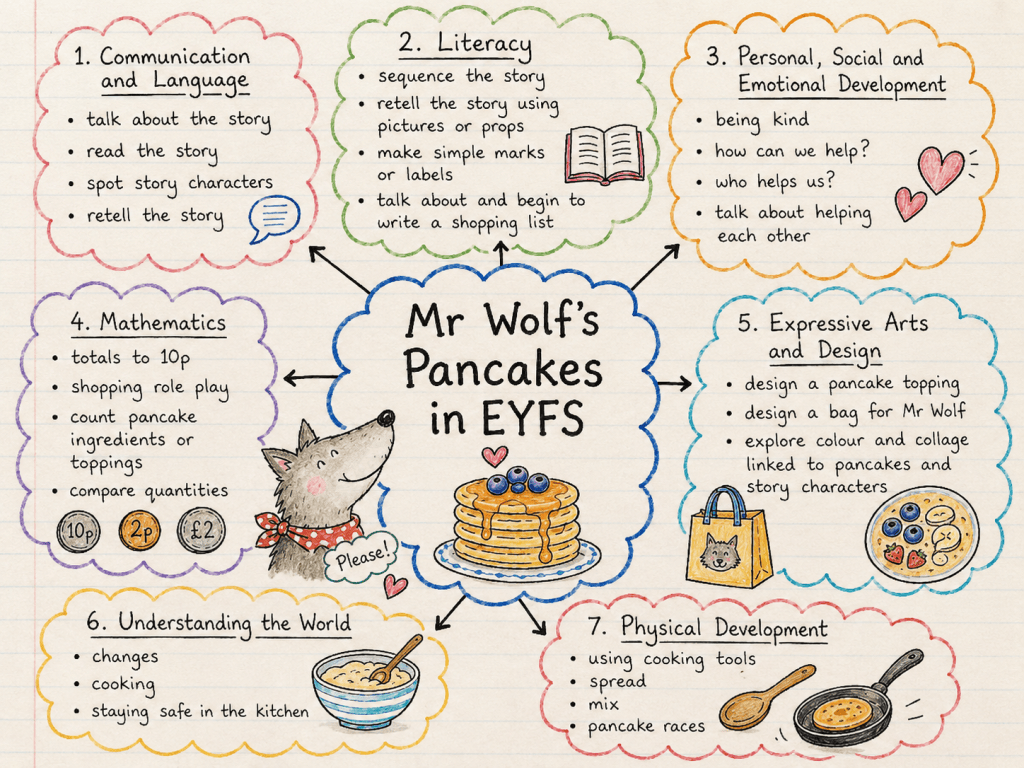
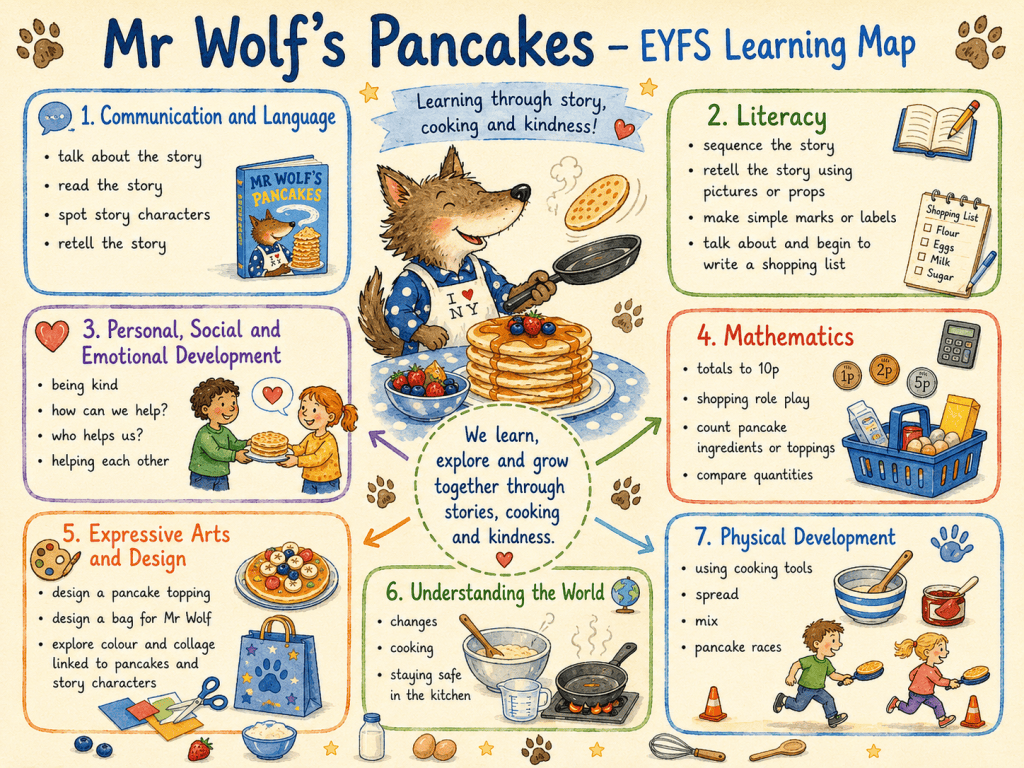
Mr Wolf’s Pancakes works beautifully in Early Years because it combines a familiar story structure with practical, hands-on experiences that children can relate to. The themes of cooking, shopping, kindness and helping others create plenty of opportunities for play, discussion and first-hand learning.
Communication and Language
- Read and discuss the story together.
- Talk about the characters and what happens in the story.
- Retell the story using props, puppets or a story box.
- Ask questions such as: Why do the neighbours say no? and How could we help Mr Wolf?
- Introduce and use vocabulary linked to cooking, shopping and feelings.
Literacy
- Sequence the story using pictures or props.
- Retell the story in their own words.
- Make simple marks, labels or lists linked to the story.
- Help to write a shopping list for Mr Wolf.
- Explore story characters and familiar story language.
Personal, Social and Emotional Development
- Talk about being kind and helping others.
- Discuss good manners and polite ways of asking for help.
- Think about who helps us in our own lives.
- Talk about how we can help each other at home or in setting.
- Reflect on how the characters’ choices affect Mr Wolf.
Mathematics
- Use 1p coins in shopping role play.
- Count ingredients or pancake toppings.
- Make simple totals using small amounts.
- Compare quantities, such as more and fewer toppings.
- Use number in meaningful contexts through shopping and cooking play.
Understanding the World
- Explore changes when ingredients are mixed together.
- Notice what happens during cooking.
- Talk about staying safe in the kitchen.
- Explore ingredients and talk about where food comes from.
- Link to Pancake Day or Shrove Tuesday where appropriate.
Physical Development
- Use cooking tools to stir, spread and spoon.
- Practise fine motor skills through mixing, pouring and handling tools.
- Make and shape playdough pancakes.
- Take part in pancake races.
- Develop control and coordination through practical activities.
Expressive Arts and Design
- Explore imaginative play linked to shopping and cooking themes.
- Design a pancake topping or decorate a paper pancake.
- Design a bag for Mr Wolf.
- Use collage, paint or printing to create artwork linked to the story.
- Act out the story through role play.
What about Continuous Provision?
This story fits naturally into continuous provision because it links so well to familiar play themes such as home, shopping, food and helping others. Rather than turning every area into a themed activity, I would add a few simple invitations to play that allow children to revisit the story in their own way.
Role Play
- Set up a pancake café, kitchen or shop.
- Add mixing bowls, spoons, pans, plates, aprons and notepads.
- Include shopping baskets, pretend ingredients and 1p coins.
- Encourage children to take orders, shop for ingredients and make pancakes.
Story Box / Small World
- Create a story box with Mr Wolf, the neighbours and key props.
- Add story characters, shopping items, a frying pan and pancakes.
- Use it for retelling the story or inventing new versions.
- Encourage children to talk through the events as they play.
Malleable Play
- Make playdough pancakes.
- Add rollers, cutters, spoons and toppings.
- Invite children to stack, count and decorate pancakes.
- Use dough to strengthen fine motor skills while linking back to the story.
Sensory Play
- Offer gloop, batter-like mixtures or safe mixing activities.
- Explore spooning, stirring, pouring and scooping.
- Compare textures and talk about changes.
- Use language such as sticky, runny, smooth and thick.
Maths Provision
- Add 1p coins for shopping role play.
- Encourage children to make small amounts and simple totals.
- Count pancake toppings, ingredients or pretend orders.
- Compare more, fewer, enough and not enough.
Writing Area
- Provide paper for shopping lists, order pads and simple labels.
- Add recipe cards, clipboards and pencils.
- Encourage children to mark-make in meaningful ways through play.
Creative Area
- Design pancakes with different toppings.
- Make bags for Mr Wolf using paper, collage and simple joining materials.
- Create pictures of Mr Wolf, the neighbours or stacks of pancakes.
The key is to let the story enhance play rather than dominate it. A few carefully chosen resources can be enough to spark rich language, imaginative role play and meaningful early learning.
Claire’s Final Thoughts
Mr Wolf’s Pancakes is a book my setting has come back to time and time again, usually around Shrove Tuesday. I particularly like the opportunities it creates to make links with other familiar stories and characters within the classic storybook genre, while still offering purposeful learning across the whole curriculum.
Some of the most memorable learning has come from the simplest ideas. My group once took the pancake-tossing challenge on one of our visits to a local care home as part of our intergenerational learning. Mini tortillas proved much sturdier than actual pancakes and worked brilliantly! It became one of those activities where movement, laughter, conversation and learning all happened together.
For me, that is where this book really shines: one familiar story can lead into cooking, maths, science, design, storytelling, relationships and shared experiences — creating plenty of opportunities for learning beyond the final page.


Leave a comment