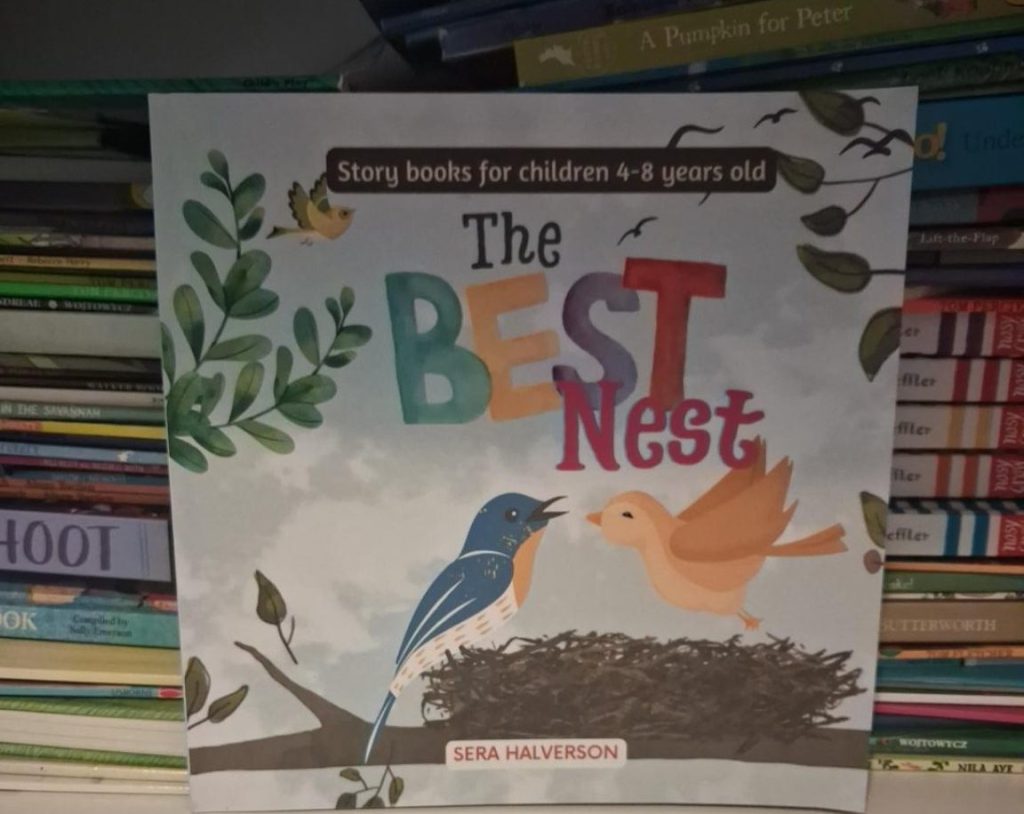
About the Book
The Best Nest by Sera Halverson follows Brown Bird as she searches for the perfect place to build her nest. She knows what she wants, but finding somewhere that feels just right is not quite as simple as she expects.
Through the story, children are introduced to the different things a bird might need from a nest — somewhere safe, comfortable and suitable for raising young — while the repeated language and clear structure make it easy for them to join in and anticipate what might happen next.
The book lends itself particularly well to exploring birds, habitats and materials, but it also opens up opportunities for language, maths, design and technology, music and personal, social and emotional development. The simple idea of looking for the “best” nest becomes a useful starting point for asking children to describe, compare, test, design and problem-solve across the curriculum.
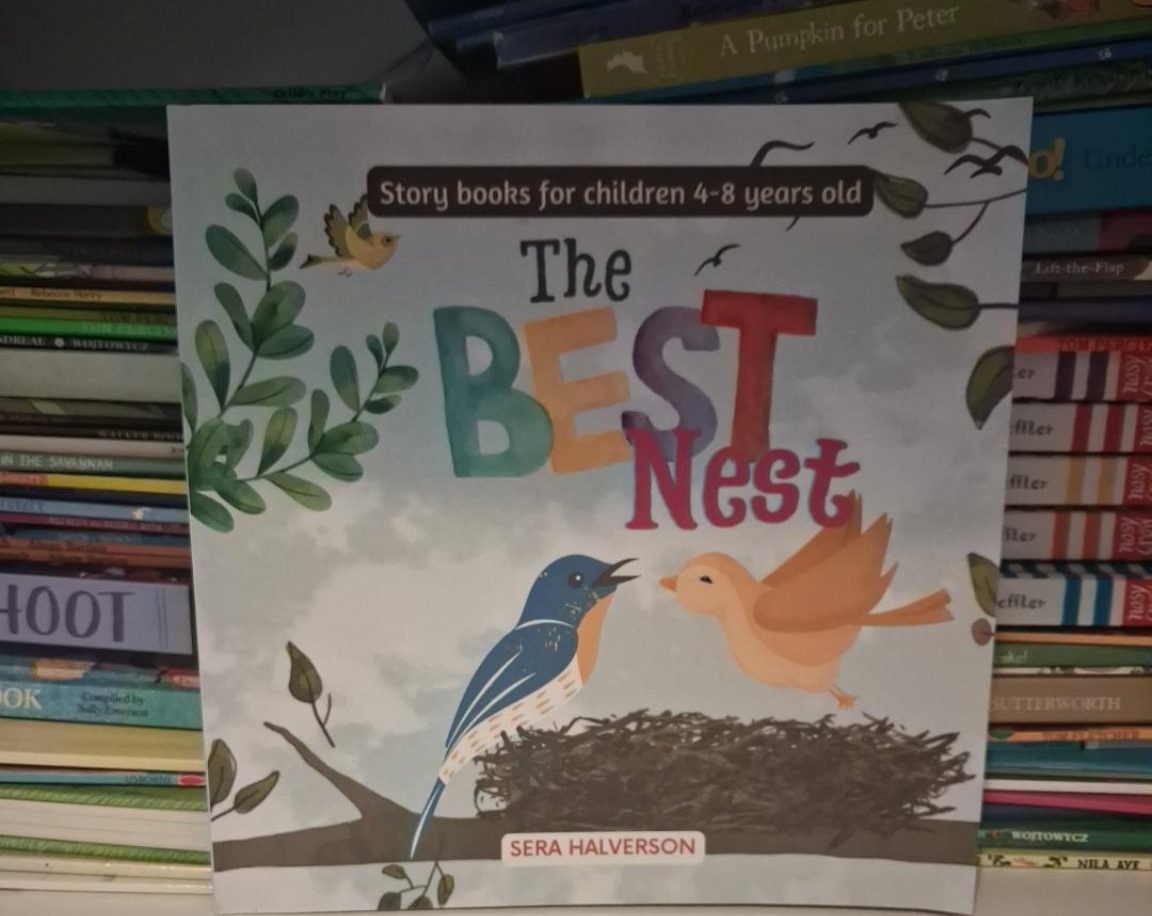
Why This Book Works
The simple sentence structure and repeating text make The Best Nest accessible to early readers, giving children opportunities to join in, anticipate repeated phrases and build confidence as they become familiar with the pattern of the story.
As Blue Bird searches for a better nest and tries to convince Brown Bird about each new possibility, the story naturally opens up discussion about what actually makes a good nest. Children can think about the advantages and disadvantages of each material or location and begin to justify their ideas.
Is a nest soft enough? Is it strong? Is it sheltered from the weather? Is it somewhere a bird would feel safe? Which materials would work well, and which might cause problems?
This makes the book particularly useful for developing reasoning and vocabulary alongside early science and design thinking. Rather than simply identifying different nests, children are encouraged to compare, evaluate and explain their choices.
Key Stage 1 Learning Opportunities
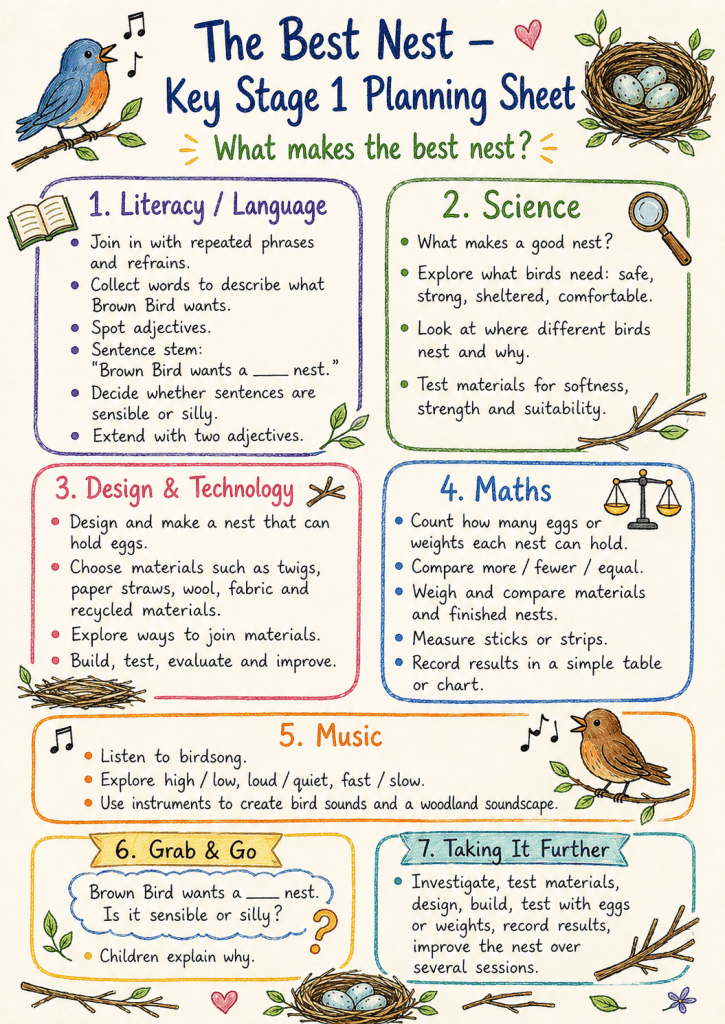
Key Stage 1 Learning Opportunities
English
The repeating sentence structure makes The Best Nest particularly accessible for early readers and gives children opportunities to join in with familiar phrases and predict what might come next.
Collect words and phrases used to describe the different nests and build a class bank of adjectives. Children can then use the sentence stem:
Brown Bird wants a ______ nest.
Add different adjectives and decide whether the resulting sentence is sensible or silly. Encourage children to explain their reasoning and extend the activity by using two adjectives, for example:
Brown Bird wants a soft, cosy nest.
Children could also identify repeated phrases in the text, explore rhyming or sound patterns, and write their own sentences describing the perfect nest.
Science
Use the story to explore the question:
What makes a good nest?
Talk about what birds need from a nest and why. Children can consider whether a nest needs to be soft, strong, sheltered, protected or waterproof, and compare different locations where birds might choose to nest.
Look at photographs of different birds’ nests and discuss how their size, shape, location and materials vary.
Provide a range of natural and everyday materials for children to investigate. Test and compare them for properties such as:
- softness
- strength
- flexibility
- absorbency
- suitability for building
Encourage children to make predictions and explain which materials they think would make the best nest.
Design & Technology
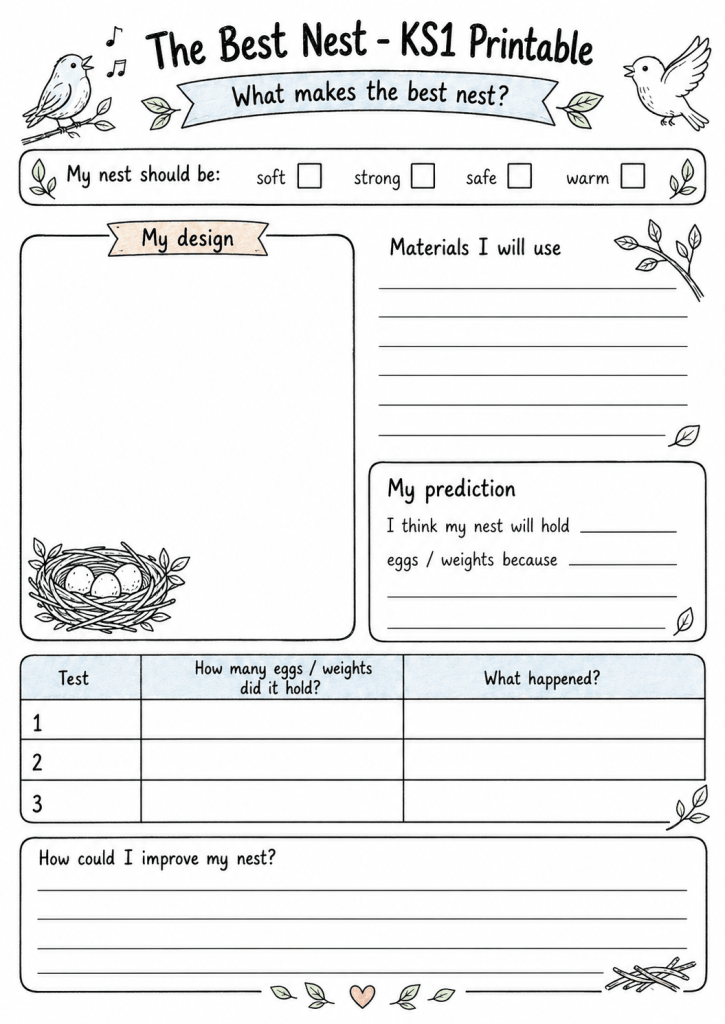
Challenge children to design and construct a nest that is strong enough to hold a collection of eggs or weighted objects.
Provide materials such as twigs, paper straws, wool, fabric, card and recycled materials. Children can explore different ways of joining and arranging them before creating their own design.
Once constructed, test the nests and encourage children to evaluate them:
- What worked well?
- What happened when weight was added?
- Which part was weakest?
- How could the design be improved?
Children can then adapt their nests and test them again, following a simple process of:
Design → Make → Test → Evaluate → Improve
Maths
The nest-building investigation provides lots of opportunities for purposeful maths.
Children can:
- count how many eggs or weighted objects each nest can hold
- compare results using more than, fewer than and equal to
- weigh and compare different nest-building materials
- compare the mass of completed nests
- measure and compare the lengths of sticks, straws or strips
- estimate before measuring
- order materials from lightest to heaviest or shortest to longest
Record class results in a simple table, pictogram or bar chart and use the data to answer questions such as:
- Which nest held the most eggs?
- How many more did it hold?
- Which nest was the lightest?
- Did the heaviest nest also hold the most weight?
Music
Listen to recordings of different birdsong and compare the sounds children can hear.
Introduce simple musical vocabulary such as:
- high and low pitch
- loud and quiet
- fast and slow
Provide percussion instruments and invite children to choose sounds that might represent different birds.
Children could recreate short birdsong patterns or work together to create a woodland soundscape inspired by the story.
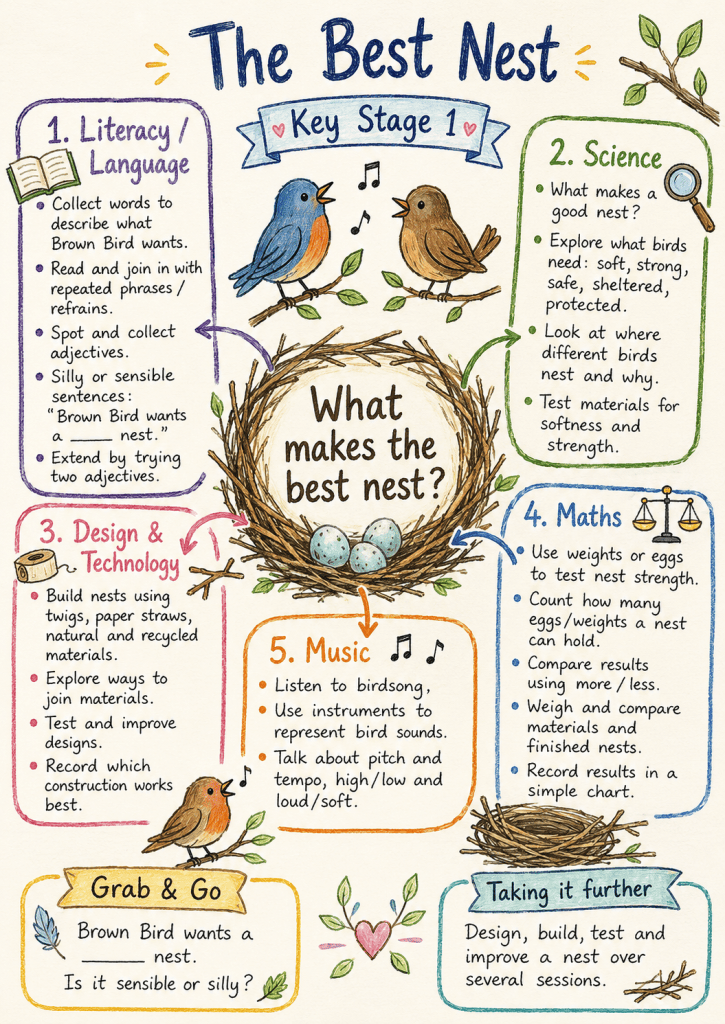
Grab & Go – Sensible or Silly?
Give children the sentence stem:
Brown Bird wants a ______ nest.
As a class, collect as many adjectives as possible to describe a nest. These might include words such as:
soft, cosy, warm, strong, tiny, huge, fluffy, spiky, shiny, muddy, wobbly or noisy.
Choose one adjective at a time and place it into the sentence.
Ask:
Is it a sensible sentence or a silly sentence?
Encourage children to explain their reasoning. Some choices may seem silly at first but lead to interesting discussion. Could a nest really be muddy? Could it be enormous? Could a shiny nest ever be useful?
Children can then create their own sensible and silly sentences.
Extend It
Challenge children to use two adjectives:
Brown Bird wants a soft, cosy nest.
Or ask them to create the silliest sentence they can while still making sure the sentence is grammatically correct.
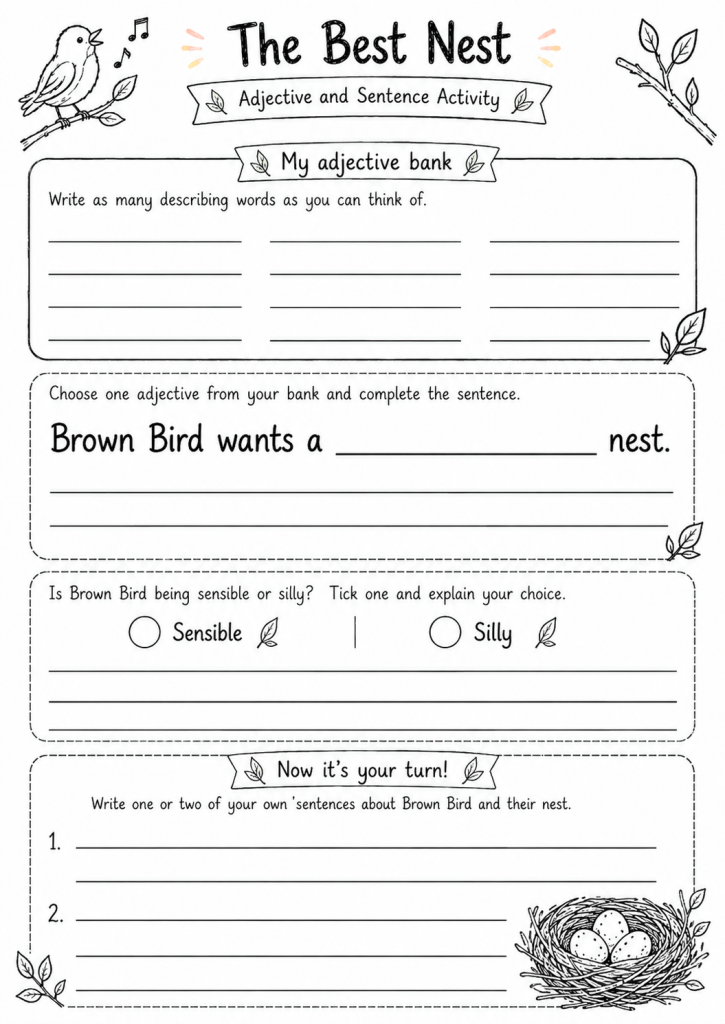
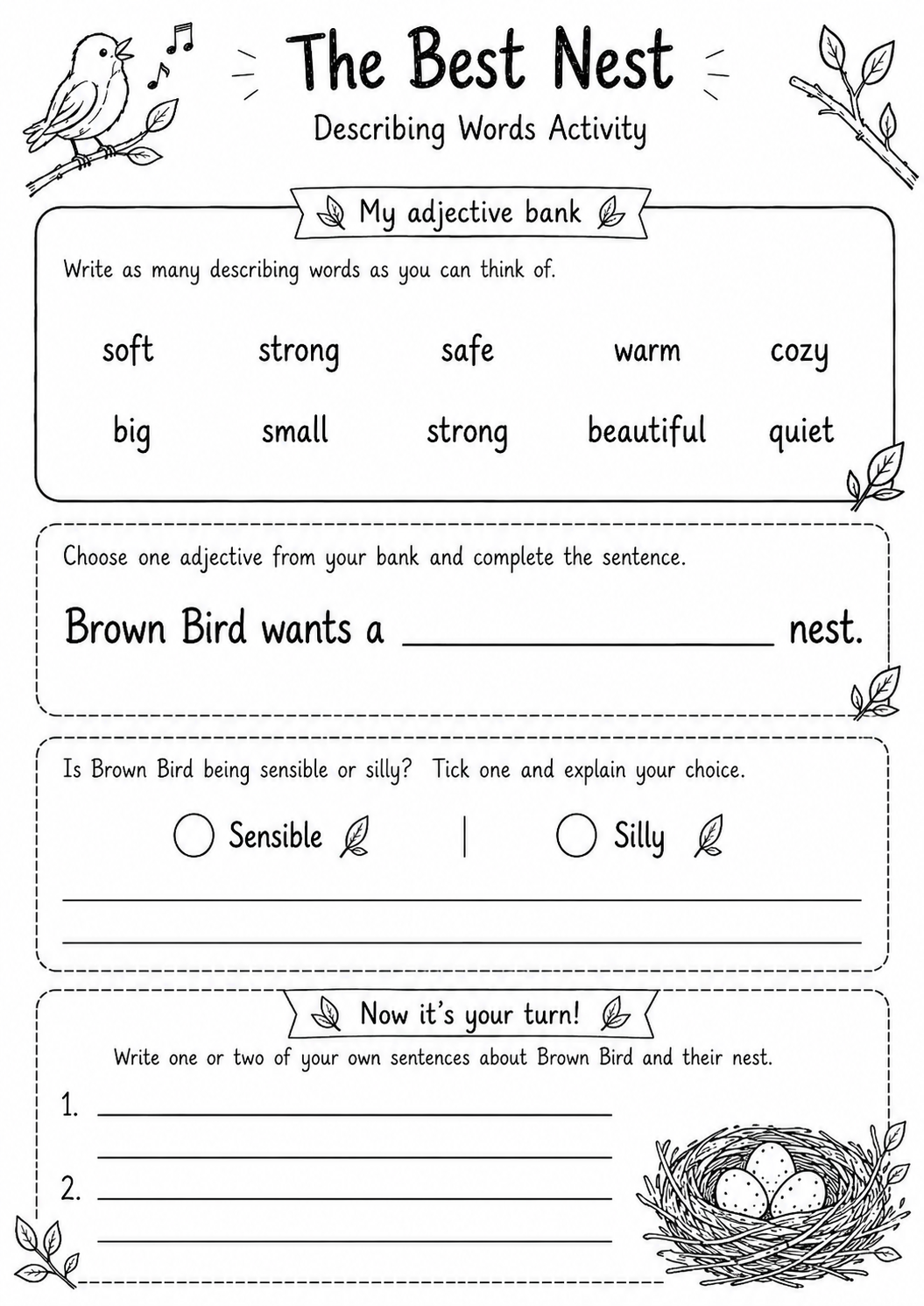
This quick activity supports vocabulary development, adjective use, sentence construction and reasoning, with very little preparation.
The Best Nest – Key Stage 1 Planning Sheet
Literacy / Language
- Read the story together and encourage children to join in with the repeated phrases and refrains.
- Collect words and phrases that describe what Brown Bird wants from her nest.
- Identify and collect adjectives from the story and generate additional describing words as a class.
- Use the sentence stem:
Brown Bird wants a ______ nest.
- Add different adjectives and decide whether the resulting sentence is sensible or silly.
- Encourage children to explain their reasoning.
- Extend the activity by using two adjectives, for example:
Brown Bird wants a soft, cosy nest.
- Challenge children to create the silliest grammatically correct sentence they can.
Science
Explore the question:
What makes a good nest?
- Discuss what birds need from a nest: somewhere safe, strong, sheltered, protected and comfortable.
- Look at photographs of different birds’ nests and compare where they have been built.
- Talk about why different birds might choose different locations or materials.
- Explore a range of natural and manufactured materials.
- Test materials for properties such as:
- softness
- strength
- flexibility
- water resistance
- Make predictions about which materials would be most suitable for nest building.
Design & Technology
Introduce the challenge:
Can you design and make a nest that will safely hold some eggs?
- Explore existing nests and how the materials are arranged.
- Select suitable materials such as twigs, paper straws, wool, fabric, paper and recycled materials.
- Draw and label an initial design.
- Explore different ways of joining materials.
- Build the nest.
- Test the finished structure.
- Identify strengths and weaknesses.
- Adapt and improve the design before testing again.
Encourage children to work through a simple design process:
Design → Make → Test → Evaluate → Improve
Maths
Use the nest-building challenge as a purposeful context for measurement and data.
- Count how many eggs or weighted objects each nest can hold.
- Compare results using:
- more than
- fewer than
- equal to
- Weigh and compare different nest-building materials.
- Compare the mass of completed nests.
- Order materials or nests from lightest to heaviest.
- Measure the length of sticks, straws or strips used in construction.
- Estimate before measuring.
- Record test results in a simple table.
- Represent class results using a pictogram, block graph or bar chart.
- Ask comparative questions such as:
- Which nest held the most eggs?
- How many more did this nest hold?
- Which nest was the lightest?
- Did the heaviest nest hold the most weight?
Music
- Listen carefully to recordings of different birdsong.
- Compare the sounds that different birds make.
- Explore:
- high and low pitch
- loud and quiet sounds
- fast and slow tempo
- Choose percussion instruments to represent different bird sounds.
- Create short birdsong patterns.
- Work individually or in groups to create a simple woodland soundscape.
Grab & Go – Sensible or Silly?
Write the sentence stem:
Brown Bird wants a ______ nest.
Generate a class collection of adjectives.
Choose one adjective at a time and place it into the sentence.
Ask:
Is it sensible or silly?
Children explain their reasoning.
Some apparently silly choices may prompt useful discussion — could a nest really be enormous, muddy, shiny or noisy?
Extend by asking children to write their own sensible and silly sentences.
Taking It Further – What Makes the Best Nest?
Develop the nest investigation across several sessions.
Session 1 – Investigate
Explore real nests, photographs and nest-building materials.
Ask:
What does a bird need from its nest?
Session 2 – Test Materials
Investigate materials for softness, strength, flexibility and suitability.
Record findings.
Session 3 – Design
Children draw and label their proposed nest and choose suitable materials.
Session 4 – Build
Construct nests using the chosen materials and investigate different ways of joining them.
Session 5 – Test
Add eggs or weighted objects one at a time.
Count and record how many each nest can hold.
Compare the results.
Session 6 – Improve
Identify what worked well and what could be changed.
Modify the nest and test it again.
Finish by returning to the original question:
What really does make the best nest?
EYFS Learning Opportunities
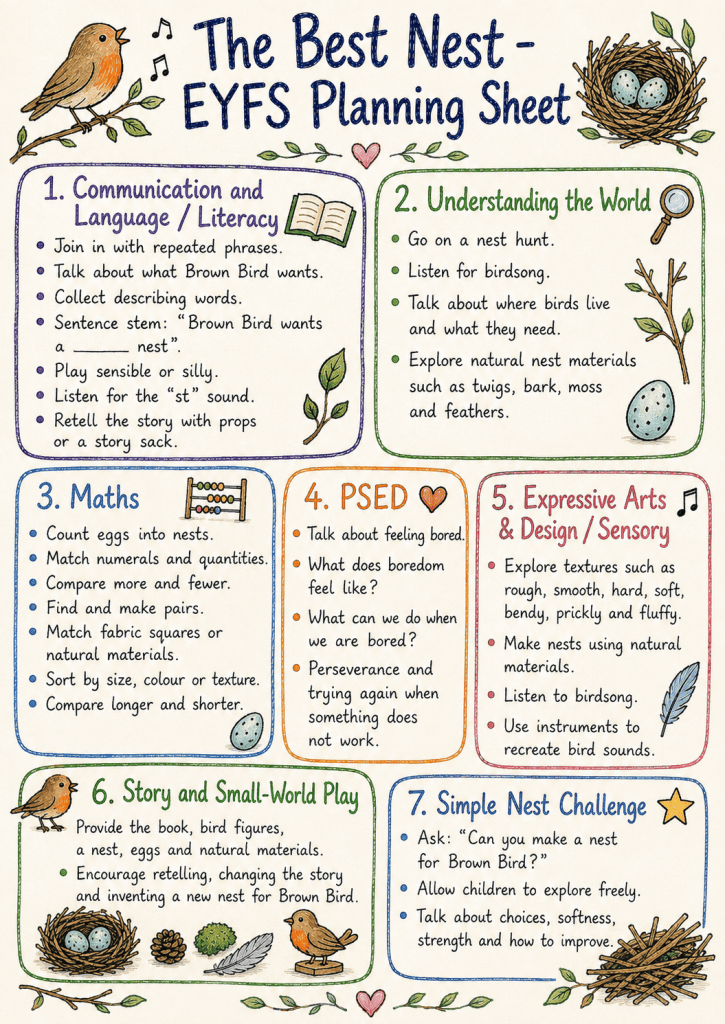
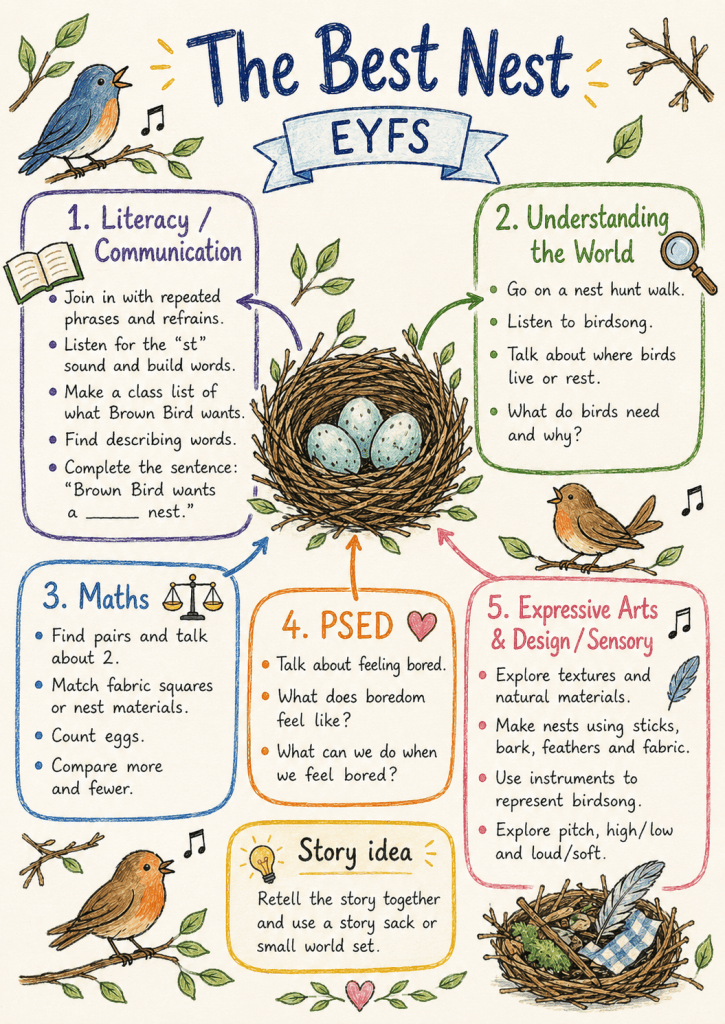
The Best Nest – EYFS Planning Sheet
Communication and Language / Literacy
- Share the story repeatedly so that children become familiar with its pattern and language.
- Encourage children to join in with repeated phrases and refrains.
- Talk about what Brown Bird wants from her nest.
- Make a class collection of describing words.
- Introduce the sentence stem:
Brown Bird wants a ______ nest.
- Add different describing words and talk about whether they make sense.
- Play sensible or silly with words such as:
- soft
- cosy
- warm
- spiky
- fluffy
- enormous
- shiny
- wobbly
- Encourage children to explain their choices.
- Listen for the st sound and collect words containing or beginning with the sound.
- Provide opportunities for children to retell the story using props, puppets, pictures or a story sack.
Understanding the World
- Go on a nest hunt outdoors.
- Look carefully in trees, bushes, roofs and other possible nesting places without disturbing wildlife.
- Listen for birds and try to identify where the sounds are coming from.
- Look at photographs of different birds and their nests.
- Talk about where birds live and rest.
- Ask:
- What does a bird need?
- Why does it need a nest?
- What might make a nest safe?
- Why might birds choose particular materials?
- Explore natural nest-building materials such as twigs, leaves, bark, moss and feathers.
- Compare their textures and properties.
Maths
Use eggs, nests and natural materials to provide meaningful mathematical experiences.
- Count eggs into nests.
- Match numerals and quantities.
- Compare groups using more and fewer.
- Find and make pairs.
- Talk about the number 2.
- Match pairs of fabric squares or natural materials.
- Sort nest materials according to:
- size
- colour
- texture
- type
- Compare sticks using longer/shorter language.
- Make simple repeating patterns using feathers, leaves, sticks or fabric.
PSED
Brown Bird’s experience provides a useful opportunity to talk about boredom.
Discuss:
- What does being bored feel like?
- How do we know when we are bored?
- What things can we do when we feel bored?
- Can we think of something to do ourselves?
- Can we ask someone to play with us?
- Can boredom sometimes help us think of new ideas?
Support children to create their own collection of things we can do when we feel bored.
Use the story to explore perseverance too:
- Brown Bird keeps trying.
- Her ideas do not always work immediately.
- What can we do when something we make does not work?
Expressive Arts & Design / Sensory Exploration
- Explore natural materials through touch.
- Compare:
- rough and smooth
- hard and soft
- bendy and stiff
- fluffy and prickly
- Create nests using sticks, bark, feathers, wool, fabric and other materials.
- Make model birds using collage, paint, clay or playdough.
- Listen to birdsong.
- Experiment with instruments to recreate bird sounds.
- Explore:
- high and low
- loud and quiet
- fast and slow
- Create a simple woodland or birdsong soundscape together.
Story and Small-World Play
Provide:
- the book
- bird figures
- a nest
- pretend eggs
- natural materials
- puppets or simple character props
Encourage children to:
- retell familiar parts of the story
- recreate favourite scenes
- change the story
- invent a new nest for Brown Bird
- introduce additional characters
A simple story sack can allow children to revisit the story independently.
Simple Nest Challenge
Provide a selection of natural and construction materials.
Ask:
Can you make a nest for Brown Bird?
Allow children to explore freely rather than expecting identical finished products.
Talk alongside the children about their choices:
- Why did you choose that?
- Is it soft?
- Will the eggs stay inside?
- What could make it stronger?
- What might you change?
The emphasis is on experimenting, talking, problem-solving and adapting rather than producing a perfect model.
What About Continuous Provision?
What About Continuous Provision?
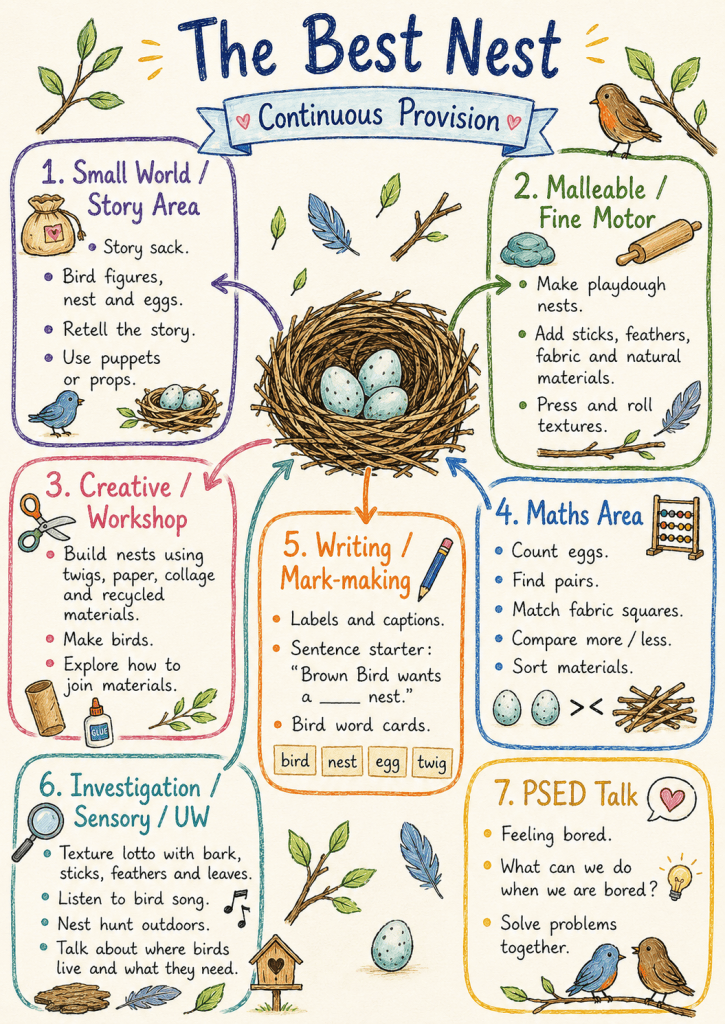
Extend the ideas from The Best Nest across the environment so children can revisit the story independently through play, investigation and exploration.
Small World / Story Area
Provide:
- bird figures
- a nest
- pretend eggs
- twigs, leaves and feathers
- simple character props
- the book or a story sack
Encourage children to retell familiar parts of the story, recreate different nest ideas or invent a completely new nest for Brown Bird.
Malleable / Fine Motor
Add natural materials to playdough or clay.
Children can:
- make nests
- press in sticks and feathers
- roll and twist materials
- explore different textures
- make eggs or birds
Talk about which materials feel soft, rough, smooth, hard or bendy.
Creative / Workshop
Provide twigs, paper, card, fabric, wool, collage materials and recycled resources.
Invite children to:
- construct nests
- make birds
- explore ways of joining materials
- test whether their nest will hold eggs
- adapt their ideas when something does not work
Maths Area
Use eggs, nests and natural materials for:
- counting
- matching numerals and quantities
- finding pairs
- comparing more and fewer
- sorting by size, colour or texture
- comparing longer and shorter sticks
- making simple patterns
Children could also count how many eggs different nests can hold.
Writing / Mark-Making
Provide bird and nest vocabulary cards alongside pencils, labels and clipboards.
Use the sentence starter:
Brown Bird wants a ______ nest.
Children can add describing words, write labels for their models or record what materials they have chosen.
Investigation / Sensory
Create a basket or tray of natural materials such as:
- bark
- twigs
- feathers
- leaves
- moss
- fabric
Encourage children to compare textures and sort the materials.
A simple texture lotto activity could involve matching pairs by touch.
Outside, go on a nest hunt or simply stop and listen for birdsong. Talk about where birds choose to live and what they might need from their environment.
Music
Provide instruments for children to explore bird sounds.
Listen to birdsong and experiment with:
- high and low sounds
- loud and quiet sounds
- fast and slow patterns
Children can create their own birdsong or woodland soundscape.
PSED
Keep the story’s theme of boredom available for discussion.
Ask:
- What does being bored feel like?
- What can we do when we are bored?
- How can we think of our own ideas?
- What can we do when something we make does not work?
This provides a natural opportunity to explore independence, perseverance and problem-solving through everyday play.
Claire’s Final Thoughts
The Best Nest was new to me when I first introduced it to my mixed-age group, but the children engaged with it immediately.
They particularly enjoyed creating their own nests using materials such as paper, sticks, feathers, pine cones, boxes and dough. The activity naturally helped to develop their vocabulary around materials, strength and suitability, as they began to talk about which resources worked well and why.
One of my older children, in Year 2, decided that he wanted to explore whether “rain” would change the strength of a material, so he extended the investigation himself by adding water and testing what happened. It was a lovely example of the learning moving beyond the original activity and becoming genuinely child-led.
Despite its simple sentence structure and repeating patterns, the book still engaged the full range of learners in my group, who were aged from 2 to 7 years. It gave younger children an accessible story they could join in with, while offering older children plenty of opportunity to question, test, investigate and extend their thinking.
For me, that is exactly what makes a deceptively simple book so valuable — it gives children an accessible starting point, but leaves plenty of room for curiosity, investigation and learning beyond the final page.


Leave a comment