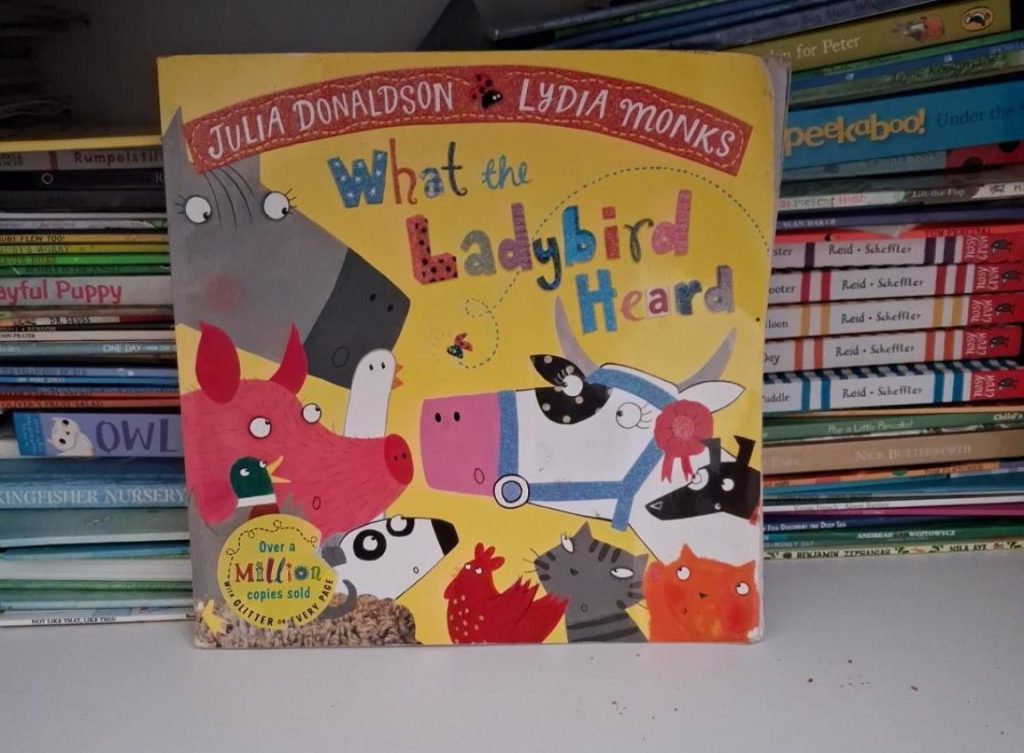
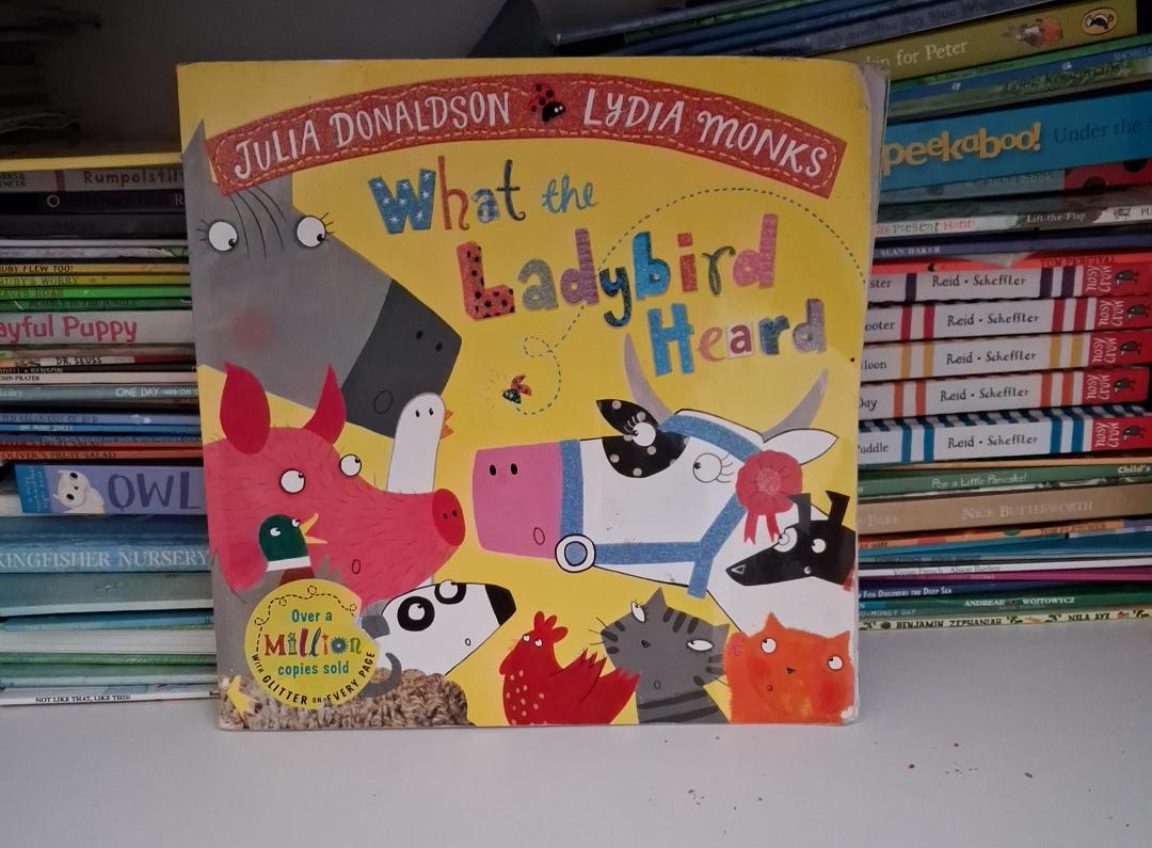
Full of a wide range of learning opportunities across Key Stage 1 and EYFS.
Why This Book Works
One of the great strengths of What the Ladybird Heard is participation.
Children very quickly learn the animal sounds and repeated phrases and can join in as the story becomes familiar. This makes it particularly supportive for developing attention, listening, memory and confidence with repeated language.
There is also some wonderfully expressive vocabulary.
The thieves are not simply big or tall — they are Hefty Hugh and Lanky Len. The cow is a fine prize cow, and the animals are described using words that give children plenty to notice and explore.
But perhaps the most interesting character is the smallest and quietest.
The ladybird says nothing for much of the story.
She listens.
And because she listens, she understands what is happening and is able to solve the problem.
This provides a lovely starting point for conversations about careful listening, observation and the idea that being quiet does not mean having nothing to contribute.
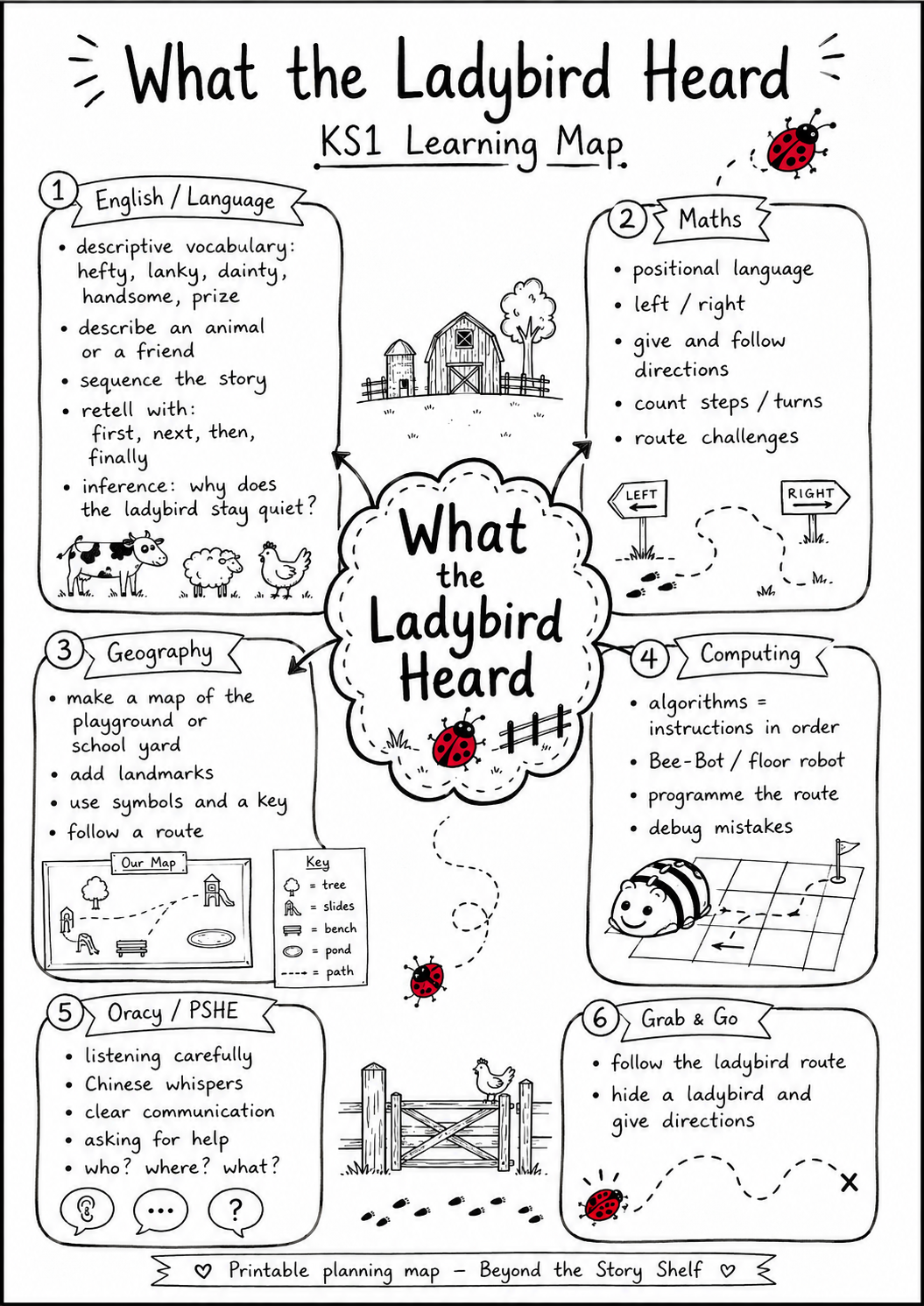
English
Collect some of the descriptive vocabulary from the story.
Explore words such as:
- hefty
- lanky
- dainty
- handsome
- prize
What do these words mean?
Can children think of another word with a similar meaning?
Why might Julia Donaldson have chosen lanky rather than simply tall, or hefty rather than big?
Children could collect adjectives used in the book and then generate their own.
Use the characters as a starting point for description.
Can children describe one of the animals without naming it?
Can their partner work out which animal they mean?
Extend this into describing a friend using positive adjectives that go beyond appearance:
- kind
- funny
- helpful
- patient
- brave
- thoughtful
The story is also ideal for sequencing.
Children can order the main events and use time connectives:
First → Next → Then → After that → Finally
Older children could write instructions for the thieves’ intended route around the farm and compare these with what actually happens.
Reading and Inference
Ask:
Why does the ladybird stay quiet at the beginning of the story?
What is she doing while everybody else is making noise?
What does she hear that the other animals do not?
How do we know she has been listening carefully?
This provides a simple introduction to inference — using what happens in the text to think about a character’s actions and motivations.
Children could also look for clues.
What do Hefty Hugh and Lanky Len plan to do?
What information does the ladybird need in order to stop them?
Maths – Position and Direction
The thieves’ route around the farm gives a purposeful context for positional and directional language.
Explore words such as:
- left
- right
- forwards
- backwards
- turn
- beside
- behind
- between
- next to
Give children simple routes to follow physically around the classroom or playground.
One child could give directions while another follows them.
Did they reach the correct destination?
What happens if one instruction is wrong?
Geography – Maps and Routes
Create a simple map of the school playground or outdoor area.
Identify familiar landmarks such as:
- gates
- trees
- benches
- climbing equipment
- sheds
- paths
- playground markings
Children can use their map to plan and describe routes.
Introduce simple symbols and create a key.
Can somebody else follow the map?
Can children give directions from one place to another?
Computing – Algorithms and Programming
The burglars have a sequence of directions to follow.
This provides a simple introduction to the idea of an algorithm — a set of instructions in the correct order.
Use a Bee-Bot, floor robot or programmable device.
Create a simple farm grid or route and ask children to programme the robot to reach a destination.
Before pressing go, predict what will happen.
If the robot goes to the wrong place:
Which instruction caused the problem?
Children can then correct — or debug — their sequence.
Oracy / PSHE
The story provides several opportunities to explore communication and listening.
Try a game of Chinese Whispers.
What happens to the message as it travels around the group?
Why does information sometimes become muddled?
What helps us listen carefully?
For older KS1 children, this could lead into simple role play around asking for help or making an emergency call.
What information would somebody need?
- Who are you?
- Where are you?
- What has happened?
- What help do you need?
The emphasis is on communicating information clearly, calmly and accurately.
Grab & Go – Follow the Ladybird
Hide a picture or model ladybird somewhere in the classroom or outdoor area.
Give children a sequence of directions.
For example:
Walk forwards five steps.
Turn right.
Walk to the bench.
Turn left.
Look underneath…
Can they follow the instructions and find the ladybird?
Extend It
Ask children to create directions for somebody else.
Older children could write their instructions using imperative verbs.
Or introduce a deliberate mistake.
Can the children work out which instruction needs changing?
This simple activity supports positional language, listening, sequencing and early algorithmic thinking with very little preparation.
[Image]
What the Ladybird Heard – Key Stage 1 Planning Sheet
Literacy / Language
- Read the story and encourage children to notice repeated language and patterns.
- Collect descriptive words from the text.
- Explore unfamiliar vocabulary such as hefty, lanky, dainty, handsome and prize.
- Generate synonyms and alternative adjectives.
- Describe one of the animals without naming it.
- Describe a friend using positive adjectives.
- Sequence the main events.
- Use time connectives to retell the story.
- Write instructions for a route around the farm.
- Compare the thieves’ original plan with what actually happened.
- Discuss why the ladybird remains quiet.
- Use evidence from the story to explain what she might be thinking or doing.
Maths
- Explore left and right.
- Follow simple directions.
- Use positional vocabulary including:
- beside
- behind
- between
- next to
- in front of
- Give a partner a route to follow.
- Count steps or movements.
- Compare shorter and longer routes.
- Identify and correct an incorrect direction.
Geography
- Draw a simple map of the playground or school grounds.
- Identify important landmarks.
- Use simple symbols to represent features.
- Create a map key.
- Describe routes using positional and directional language.
- Follow another child’s map.
- Discuss what makes a map easy to understand.
Computing
- Introduce the idea of an algorithm as a sequence of instructions.
- Programme a Bee-Bot or floor robot along a route.
- Predict where the robot will finish.
- Test the instructions.
- Identify mistakes.
- Debug and improve the programme.
- Challenge children to find more than one route to the same destination.
Oracy / PSHE
- Discuss why listening is important.
- Explore the difference between hearing and listening.
- Play Chinese Whispers and talk about why messages change.
- Practise giving clear information.
- Role-play asking an adult for help.
- With older children, practise the sort of information that might be needed in an emergency:
- who
- where
- what
- what help is needed
Taking It Further – Maps, Routes and Instructions
Develop the mapping and direction work across several sessions.
Session 1 – Explore the Story Route
Revisit the burglars’ plan.
Can children identify the places they intend to pass?
Act out the route together.
Session 2 – Direction Words
Practise:
- forwards
- backwards
- left
- right
- turn
Give and follow simple instructions.
Session 3 – Make a Map
Go outside and identify useful landmarks.
Draw a simple map of the playground or school grounds.
Session 4 – Plan a Route
Choose a starting point and destination.
Draw or write a route between them.
Session 5 – Programme It
Transfer the idea to a Bee-Bot, floor robot or simple grid.
Programme a sequence of movements.
Session 6 – Debug It
Introduce an incorrect instruction.
Can children identify where the route goes wrong and fix it?
Finish by returning to the story.
Why did the thieves’ route go so badly wrong?
EYFS Learning Opportunities
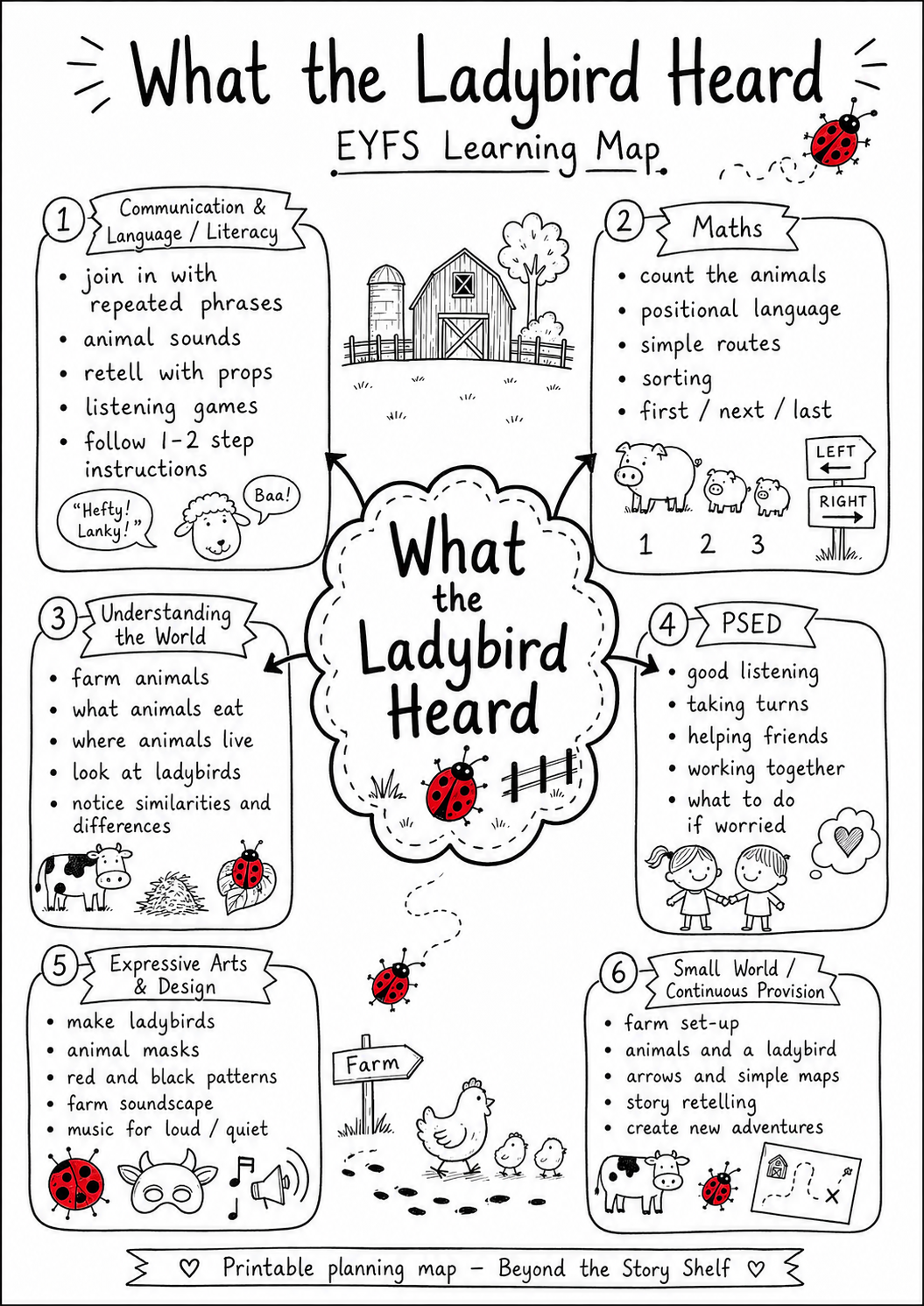
EYFS Learning Opportunities
Communication and Language / Literacy
- Join in with the repeated phrases and animal sounds.
- Match animals to the sounds they make.
- Retell the story using figures, puppets or small-world props.
- Sequence key events from the story.
- Explore descriptive vocabulary such as hefty, lanky, dainty, handsome and prize.
- Talk about what the words mean and use them to describe other animals or people.
- Listen for sound words and use them as a playful way into recognising long vowel sounds and digraphs.
- Play listening games and talk about the importance of listening carefully.
- Follow simple one-step and two-step instructions.
- Ask why the ladybird stays quiet and what she might be listening for.
Maths
- Count the animals in the story.
- Sort animals by type, size or number of legs.
- Use positional language such as:
- next to
- behind
- in front of
- between
- under
- over
- Follow simple routes.
- Use first, next and last when sequencing events.
- Introduce forwards, backwards, left and right through physical movement.
- Create simple pathways using arrows, blocks or floor markers.
Understanding the World
- Explore different farm animals and where they live.
- Talk about what farm animals eat.
- Compare animals and notice similarities and differences.
- Look closely at ladybirds and other small creatures.
- Talk about how something very small can still be important.
- Explore farms, farm buildings and the jobs people do there.
- Make simple maps of a farm or outdoor area.
Personal, Social and Emotional Development
- Talk about what good listening looks like.
- Practise taking turns in conversation.
- Think about how we know when somebody else wants to speak.
- Explore how the animals work together to solve a problem.
- Talk about helping friends.
- Discuss what children can do if they are worried or need help.
- Reinforce the idea that everyone has something important to contribute, even if they are quiet or small.
Expressive Arts and Design
- Create ladybirds using paint, collage, printing or playdough.
- Explore red and black patterns.
- Make animal masks for story retelling.
- Use instruments to represent different farm animals.
- Explore loud and quiet, fast and slow sounds.
- Create a farmyard soundscape.
- Act out the story through role play, music and movement.
Small World and Story Play
Provide farm animals, a farmer, a ladybird, simple buildings, vehicles, fences, maps and direction arrows.
Children can:
- retell familiar parts of the story;
- recreate the thieves’ route;
- move characters around a simple map;
- invent new routes;
- create their own adventures for the ladybird;
- use positional and directional language naturally through play.
Simple Listening Challenge
Sit quietly together for one minute.
What can the children hear?
Listen again.
Can they notice quieter sounds this time — birds, footsteps, a clock, traffic, voices from another room?
Talk about how the ladybird notices something important because she takes the time to listen.
What about Continuous Provision?
Extend the ideas from What the Ladybird Heard across the environment so children can revisit the story through play, talk and exploration.
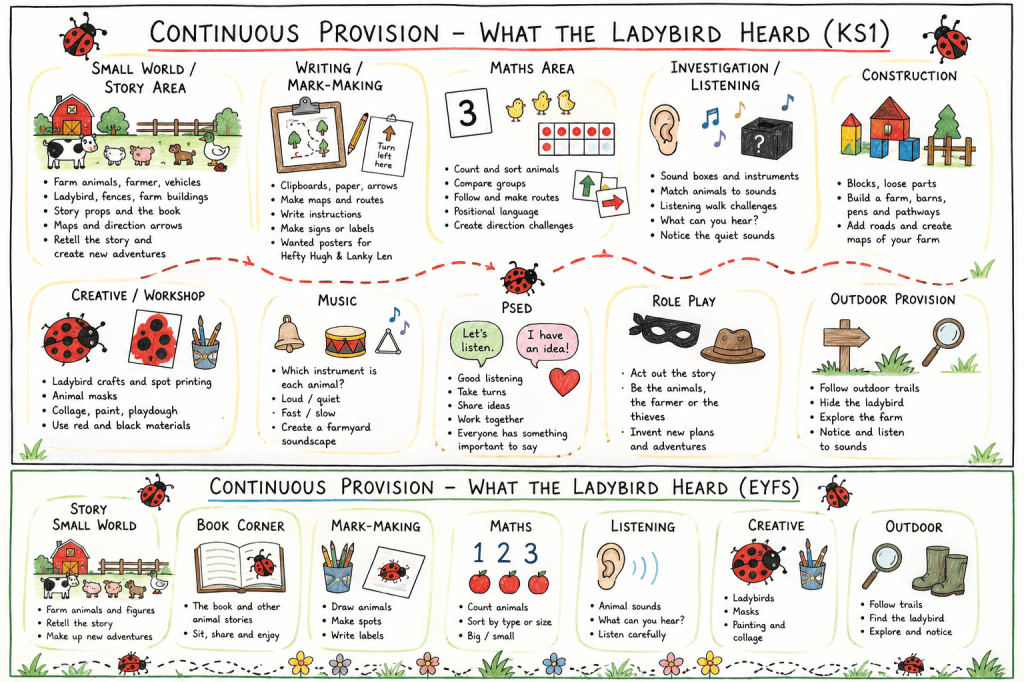
Small World / Story Area
Provide:
- farm animals
- a ladybird
- farm buildings
- fences
- vehicles
- simple maps
- direction arrows
- character figures
- the book
Encourage children to retell the story or create new routes around the farm.
Writing / Mark-Making
Provide clipboards, pencils, maps and arrow cards.
Children can:
- make signs for the farm
- draw routes
- create simple maps
- label animals
- make wanted posters for Hefty Hugh and Lanky Len
- draw or write instructions
Maths Area
Add farm animals and simple route cards.
Children can:
- count animals
- sort them
- compare groups
- follow positional instructions
- make routes using arrows
- move animals forwards and backwards
- create their own direction challenges
Investigation / Listening
Provide sound-making objects or recorded environmental sounds.
Can children identify a sound without seeing what made it?
Try matching animals to their sounds.
Create a listening station or go on a listening walk outside.
Construction
Use blocks and loose parts to build:
- a farm
- barns
- animal pens
- roads
- pathways
Children can then create maps and routes through what they have constructed.
Creative / Workshop
Provide red and black materials for ladybird-inspired artwork.
Try:
- printing
- collage
- playdough
- paint
- symmetrical spot patterns
Children could also make simple animal masks for retelling the story.
Music
Explore the noisy farm through instruments.
Which instrument might represent:
- the cow?
- the horse?
- the duck?
- the dog?
- the ladybird?
Experiment with:
- loud and quiet
- fast and slow
- long and short sounds
Create a whole-group farmyard soundscape.
PSED
Keep the idea of careful listening available throughout the day.
Notice and praise moments when children:
- wait for somebody else to finish speaking
- follow an instruction carefully
- notice something others have missed
- communicate an idea clearly
- work together to solve a problem
Claire’s Final Thoughts
What the Ladybird Heard is a very Early Years-heavy text and lends itself beautifully to both Nursery and Reception.
In my own mixed-age group, I used it to extend children’s descriptive vocabulary and to explore the sound words running through the story. Those repeated animal noises also provide a lovely, playful way into recognising long vowel sounds and digraphs.
But, for me, the most important message sits underneath all of that.
Julia Donaldson, in her inimitable way, reminds children that being small does not mean being powerless.
The ladybird is tiny. She is quiet. She does not dominate the farmyard.
But she listens, notices, thinks — and when it matters, she changes everything.
That feels like a particularly important message for young children:
you may be small, but you can still be powerful.
And that is exactly the kind of idea that takes learning beyond the story shelf.


Leave a comment