Having finished my historical short-story trilogy, I wanted to take things a step further.
During my family-history research, I became aware of a branch of the family who had emigrated from the pit villages of South Yorkshire to Australia in search of a better life. Their story stayed with me: family fracture, mining life, escape, ambition, displacement and the possibility of beginning again somewhere entirely new.
With my trilogy, I had retained the identities of the people involved and kept the stories primarily factual. I wanted to tell their stories as faithfully as I could, almost in their own voices — particularly in Tommy’s case, where I had the enormous privilege of hearing his memories in his own words.
Fiction felt different.
For a while, I had two stories germinating.
The first was Grandma’s House: the story of the occupants of a house in Ripon through the generations, beginning with its family legend as a former coaching inn and eventually becoming the home my own family knew. I had visions — if not quite Downton Abbey upstairs and downstairs — of at least a smaller, middle-class echo of that world: owners, servants, tradespeople, tenants and families moving through the same rooms while the house quietly witnessed their lives.
I still love that idea.
But after many hours of research, I realised I had not yet found the thing that made the story come alive.
Because the house is real, and because its history is connected with real people, I feel a responsibility to anchor anything I write firmly in historical evidence. At the moment there are still too many gaps. I have names, maps, rate books, dates and fragments — but not yet enough of the people themselves.
So that book is still germinating.
It simply isn’t ready.
And I realised I needed a story that grabbed me now: something with intrigue, emotion and heart.
That brought me back to the family who left South Yorkshire for Australia.
I began with the pieces of family knowledge that had survived: pit life, difficult relationships, fractured families, disability, opportunity and the hope that life might somehow be different on the other side of the world.
But this time I didn’t want to write biography.
I wanted to ask: what might it have felt like?
What would make someone leave everything familiar behind? What would it feel like to board a ship knowing that home was thousands of miles away? What opportunities did Australia really offer a working-class British family in the post-war years? And what happened when the dream of a better life collided with the ordinary complications of being human?
Because some of the people who inspired the story are still living, I have deliberately moved the novel away from the real family. Names, relationships, circumstances and events are being changed. The history will be real, but the people will belong to the novel.
That distinction feels important.
My first book was about uncovering lives that had already been lived.
This one is about taking the smallest spark from the past and asking where imagination might carry it.
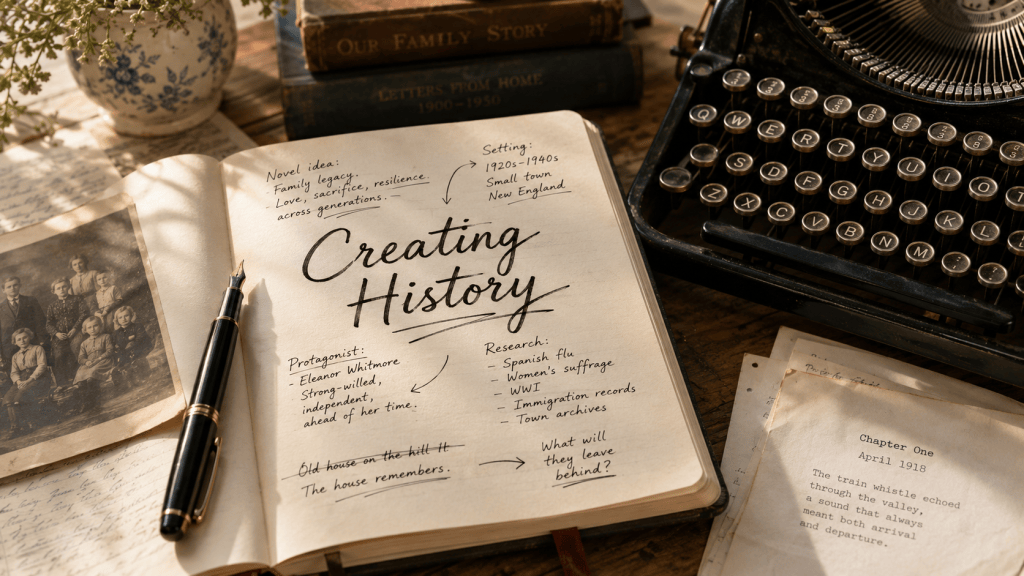
And perhaps that is what Creating History is really going to be about.


Leave a comment