
Creating a Village
Creating History: Building Cragford Vale
A key part of any story is its setting.
I knew that I wanted my novel to begin in a South Yorkshire mining community, but I didn’t want to be slavishly tied to one real geographical place. I wanted the freedom to create streets, buildings and landmarks where I needed them, while still making the village believable enough that a reader might reasonably expect to find it on a map.
So I had to build one.
This has probably been the most fun part of the process so far.
I began with words.
I started collecting the endings of real northern place names — -by, -ton, -ville, -ford and others — and researching where they came from and what they actually meant. Rather than simply inventing something that sounded vaguely Yorkshire, I wanted the name to have a reason for existing.
My first attempt was Carnforth.
I was rather pleased with that.
Unfortunately, I had not invented Carnforth at all. It is, of course, a perfectly real place in Lancashire. Somewhere in the darkest recesses of my mind I had obviously stored it away and then triumphantly presented it back to myself as an original creation.
Back to the drawing board.
Eventually, I arrived at Cragford Vale.
Ford is an old place-name element meaning a place where a river or stream could be crossed, while crag gives me the rocky outcrop above the settlement. Vale places the community down in the valley beneath it.
It sounded right.
And once Cragford Vale had a name, it began to acquire a life of its own.
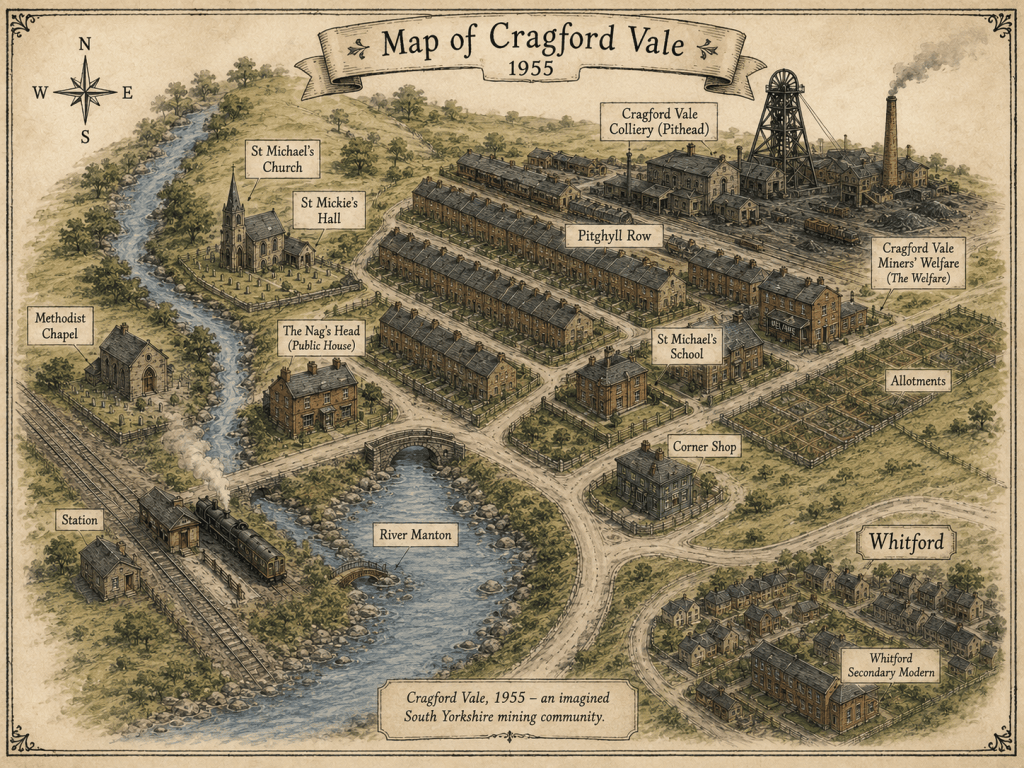
I mind-mapped the places that a mining community would need: the church, pub, school, shops, community spaces and, of course, the pit itself. I began thinking not just about what existed, but where everything sat in relation to everything else.
Where would the miners live?
Which road would the children take to school?
Where would people meet?
Where would they hear the gossip?
Where would you go if you wanted to avoid being seen?
Suddenly I wasn’t merely creating a backdrop. I was creating a community.
For the main row of pit cottages, I settled on Pitghyll Row.
A ghyll — or gill — is an old northern word for a narrow, steep-sided valley or ravine, often with a stream running through it. Row gave me the tightly packed terraces I could already see in my mind.
Pitghyll Row sounded a little stark.
That was exactly what I wanted.
Then there was the church.
I played with several names and initially rather liked St Olave’s, but it didn’t feel quite right for Cragford Vale. Eventually I settled on the much more solid St Michael’s.
And almost immediately realised that its parish hall would never actually be called St Michael’s Parish Hall by the people who used it.
It became St Mickie’s.
That tiny detail delighted me far more than it probably should have.
This has been one of the unexpected pleasures of creating a fictional place: being able to play with language while still giving that language a purpose.
There are real historical elements woven through it too.
Cragford Vale needed a Miners’ Welfare Social Club — inevitably known simply as The Welfare. Welfare halls, institutes, clubs and recreation facilities were an important feature of mining communities, providing places for sport, entertainment, meetings and social life.
That sent me down another research path.
What would schooling have looked like for children growing up there during the period of the novel? Would the secondary school have been mixed or single-sex? Grammar school or secondary modern? At what point would children have been separated according to the results of the eleven-plus?
Every answer creates another question.
Then came the pub.
I didn’t want a King’s Head, George and Dragon or Richard III. To me, they sounded too picturesque — somewhere you might stop for Sunday lunch after walking through a pretty village.
Cragford Vale needed something more grounded.
So it acquired The Nag’s Head.
I can already see its public bar.
And because I had put -ford into the name, I had created another problem for myself.
You can’t really have a ford without something to cross.
Cragford Vale therefore needed a river.
For reasons I can’t entirely explain, the River Manton immediately felt right.
And that is how a place that didn’t exist began to grow.
A name created a river.
A church created St Mickie’s.
The pit created Pitghyll Row and The Welfare.
The families created the school, shops, streets and gathering places around them.
Bit by bit, Cragford Vale has developed a believable identity, borrowing the historical features of real mining communities without forcing the story to follow the geography or history of one particular place.
It isn’t on any map.
But increasingly, I feel as though I know where everything is.
And perhaps that is the point at which an imaginary setting starts becoming real.
And that is how a place that never existed slowly began to feel real.
Bit by bit, Cragford Vale acquired its river, terraces, church, school, pub and pit — until I could finally begin to see it for myself.
Who would live in Cragford Vale?


Leave a comment