Why This Book Works
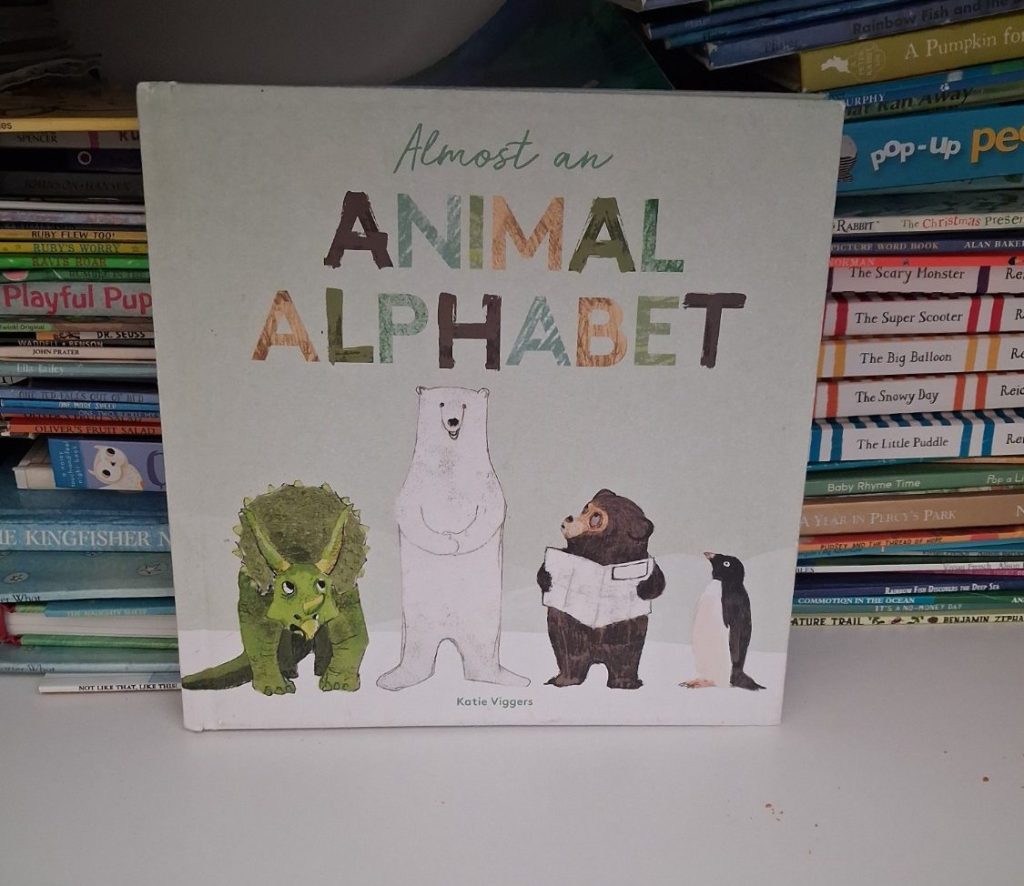
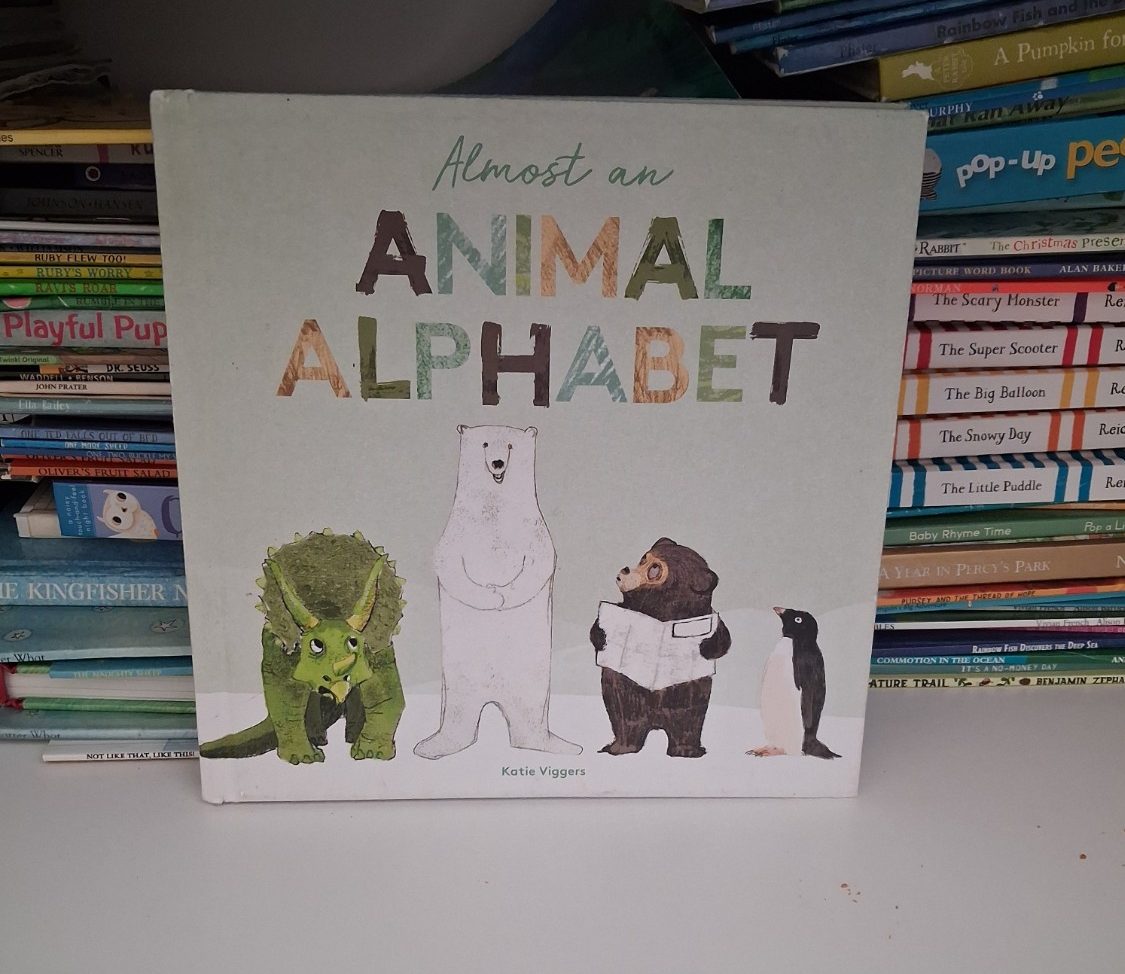
On its most basic level, Almost an Animal Alphabet is a book about initial letters and sounds. Children can enjoy spotting the animals, matching them to their letters and exploring the alphabet as they turn the pages.
But its simplicity is also its strength. Each animal provides a starting point for learning that can travel far beyond phonics. We can sort and classify animals, count legs and compare sizes, explore habitats and adaptations, investigate where animals live in the world, develop new vocabulary and begin to research and record facts.
The alphabet itself provides opportunities too. Children can explore alphabetical order, organise animal names and discover what happens when two words begin with the same letter.
It is one of those books that can be enjoyed simply as a picture book, dipped into for a quick activity, or used as the starting point for a much wider investigation. A is for alphabet — but it certainly doesn’t have to stop there.
Key Stage 1 Ideas
Key Stage One Learning
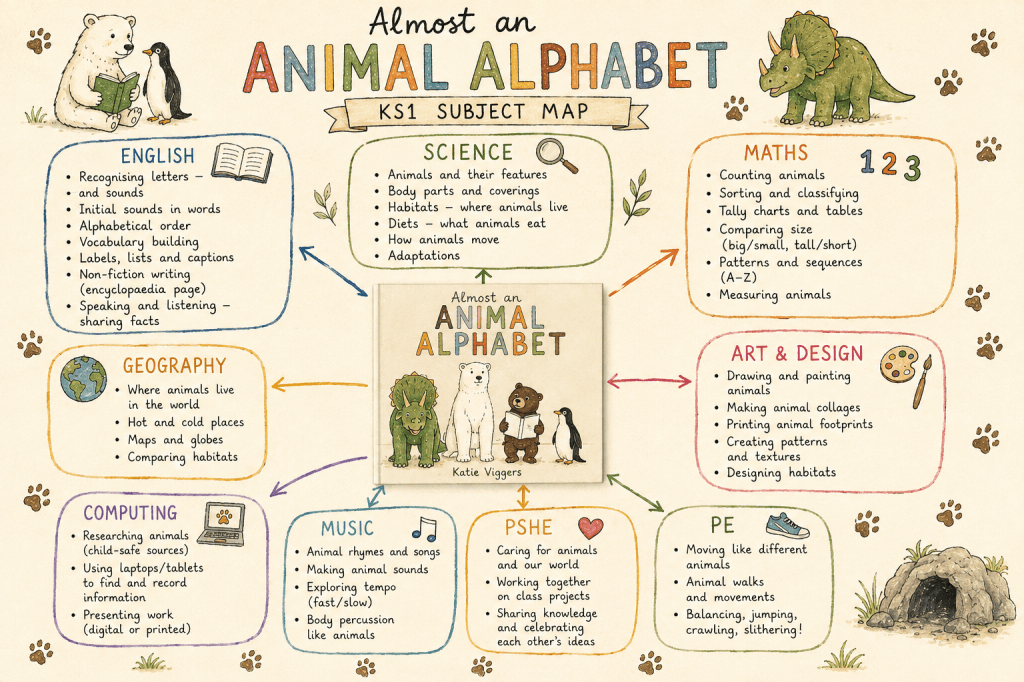
Almost an Animal Alphabet offers plenty of opportunities to move beyond initial sounds and use the animals as starting points across the curriculum.
English
Explore initial letters and sounds, build animal vocabulary and practise alphabetical order. Children can create labels, captions and animal descriptions before moving into non-fiction writing by researching an animal and producing their own encyclopaedia page. Encourage children to share their facts orally too.
Science
Identify and name different animals and look closely at their features. Compare body coverings such as fur, feathers, scales and skin; investigate what animals eat and how they move; sort animals into groups; and explore how particular features help animals survive in their habitats.
Mathematics
Count and compare animals and their features — How many legs? Which is taller? Which is longer? Sort and classify animals using different criteria, record findings using tally charts or simple tables, and explore patterns and sequences through the alphabet.
Geography
Find out where the different animals live. Locate countries and continents on maps or globes, investigate hot and cold environments and compare contrasting habitats. Children could begin to notice how an animal’s features are connected to the place in which it lives.
Art and Design
Draw, paint or collage favourite animals, paying attention to shape, colour, pattern and texture. Explore animal markings and create prints inspired by footprints, scales, feathers or fur.
Computing
Use age-appropriate digital resources to research an animal and find specific information such as its habitat, diet, size and endangered status. Children can use what they discover to contribute to the class animal encyclopaedia.
Music
Explore the sounds animals make and use voices, instruments and body percussion to represent different animals. Experiment with contrasts such as loud/quiet and fast/slow, or create a short animal soundscape.
PE
How might each animal move? Explore crawling, jumping, slithering, prowling, flying and balancing, changing speed, level and direction to represent different animals.
PSHE
Use collaborative activities to encourage children to share ideas, listen to one another and contribute to a shared outcome. Creating a class alphabet display or animal encyclopaedia gives every child something of their own to contribute while working towards a collective finished piece.
Grab & Go: Our Class Alphabet
Perfect for: A new or newly blended class, name recognition, alphabetical order and creating an instant classroom display.
You will need:
Paper or card, pencils or colouring materials, old magazines/catalogues, scissors and glue.
What to do
Give each child a piece of paper or card and ask them to create a self-portrait. Underneath, they add their first name. They might write it themselves, copy from a name card or hunt through old magazines to cut out the letters they need and collage their name.
Once everyone’s portrait is complete, bring the class together. Can the children arrange themselves — or their portraits — in alphabetical order by first name?
Start by looking at the initial letter. Who comes first? Who comes next? What happens if several children have names beginning with the same letter? For KS1 children, this is a lovely opportunity to discover that sometimes we need to look at the second, third or even fourth letter to decide where a name belongs.
Finally, mount the portraits together in alphabetical order to create Our Class Alphabet.
Why we like it
This is a genuinely grab-and-go activity with a purpose. Children practise name recognition, letter formation and alphabetical order while learning the names and faces of their classmates.
And at the end of it, you have an instant class display in which every child has a place — particularly lovely at the beginning of a new school year or when two groups of children have been brought together.
Taking It Further: Our Animal Encyclopaedia
Take the learning beyond the alphabet by working together to create a class animal encyclopaedia.
Give each child an animal to investigate, or let them choose their own. You might encourage the class to select animals beginning with different letters so that, between you, you can cover as much of the alphabet as possible.
Become an animal researcher
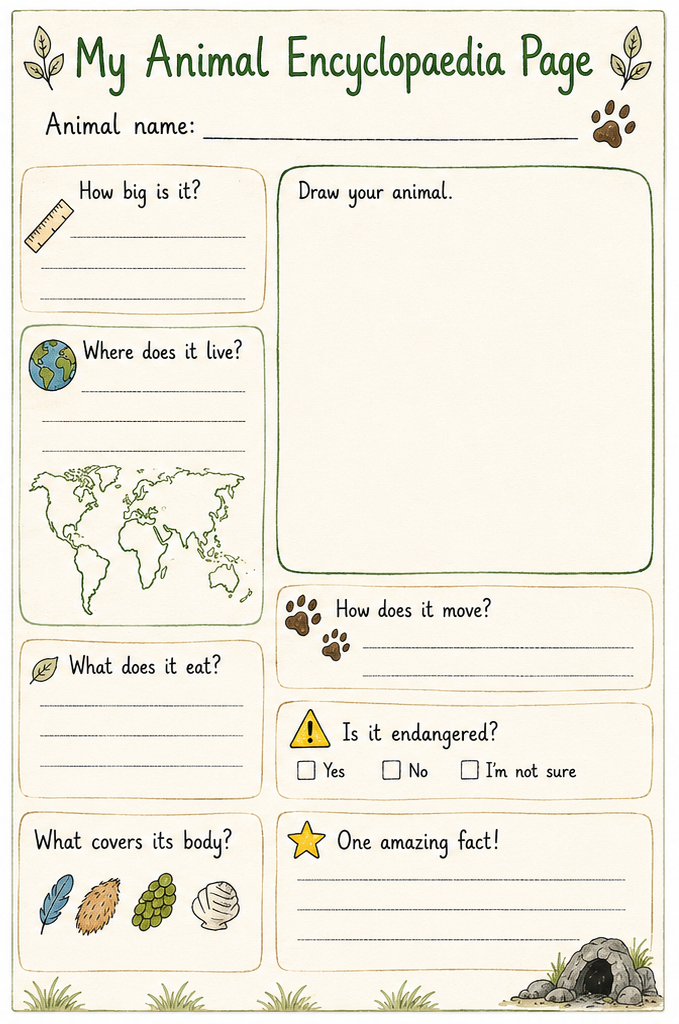
Using books, animal encyclopaedias and age-appropriate online resources, ask children to find out:
- Where does the animal live?
- How big is it?
- What does it eat?
- What covers its body — fur, feathers, scales or skin?
- How does it move?
- Is it endangered?
- What is one particularly interesting or surprising fact?
Children can record their findings on the My Animal Encyclopaedia Page, adding a carefully observed drawing of their animal.
This is a good opportunity to talk about research skills too. Where did we find our information? Did two sources tell us the same thing? How can we decide which information is useful?
Make the encyclopaedia
Once everyone’s page is finished, there is one final challenge:
What order should the pages go in?
Bring the pages together and ask the children to arrange the animals alphabetically. If two animals begin with the same letter, they’ll need to look further into each word to work out which comes first.
Add a cover, contents page and perhaps an index before binding the pages together to make Our Animal Encyclopaedia for the classroom reading or reference area.
Taking it even further
Your encyclopaedia doesn’t have to be finished. Leave some blank pages and encourage children to add new animals as they discover them throughout the year.
What begins with a simple A–Z picture book has now become a child-created reference book involving English, science, geography, computing, art and maths — with every child contributing their own piece of expertise.
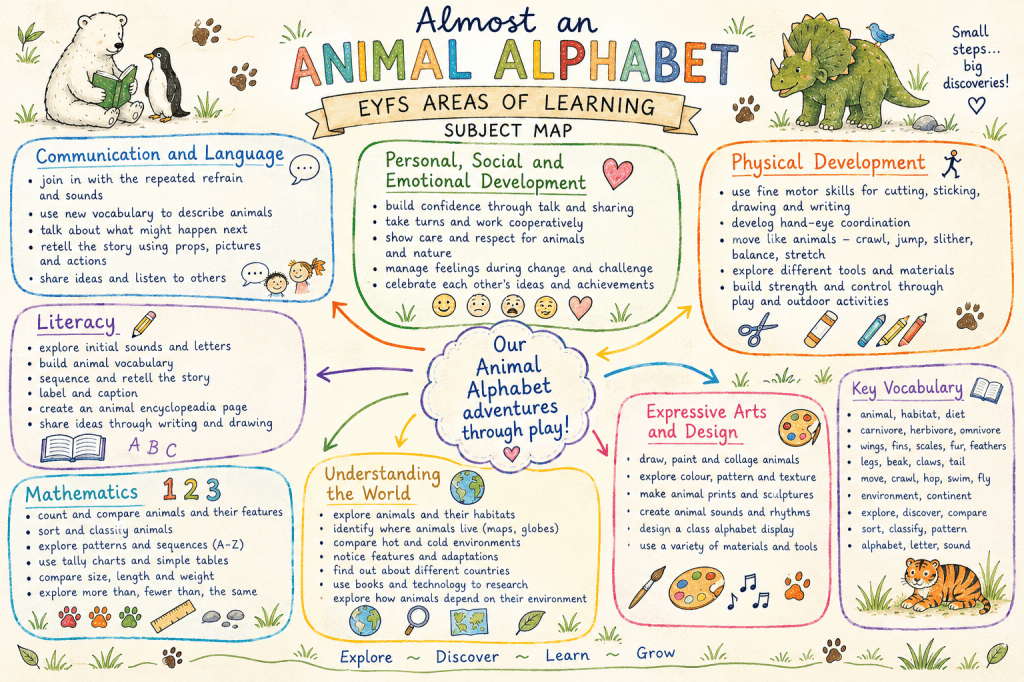
EYFS Areas of Learning
EYFS Activities
With younger children, Almost an Animal Alphabet can begin with the simple pleasure of spotting animals and playing with their names and sounds. From there, the book can move naturally into talk, movement, sorting, investigation and creative play across the EYFS.
Communication and Language — Animal Talk
Take time to look closely at the illustrations rather than rushing through the alphabet. What can the children see? What do they already know about each animal? Introduce new words for body parts, movement, habitats and animal features and encourage children to describe and compare what they notice.
Try an animal guessing game too. Describe an animal without naming it: It has feathers, it has two legs, it can swim… Can the children work out which animal you mean?
Personal, Social and Emotional Development — Working Together
Use animal activities as opportunities for children to collaborate, take turns and share their knowledge. Children could work together to sort a collection of animals, create a habitat or contribute pictures and ideas to a shared class display.
Celebrate the fact that different children will know different things. One child might know all about dinosaurs while another knows about farm animals or creatures found in the garden — everyone can bring something to the learning.
Physical Development — Move Like an Animal
Clear some space and explore the different ways animals move. Can you stomp like an elephant, waddle like a penguin, slither like a snake, hop like a frog or prowl like a tiger?
Vary the challenge by changing speed, direction and level. Fine-motor skills can be developed through drawing animals, cutting and sticking for collage, manipulating small-world animals and creating animals from dough or modelling materials.
Literacy — Animal Alphabet
Enjoy playing with the initial sounds in animal names. Find the matching letter, sort animals by their initial sound or see how many animals the children can think of beginning with a particular letter.
Provide alphabet cards, magnetic letters and animal pictures for children to explore independently. Children might label their drawings, make their own animal alphabet books or begin to record simple facts about favourite animals.
Don’t worry if you can’t find an animal for every letter — the book is called Almost an Animal Alphabet after all!
Mathematics — Sort, Count and Compare
A basket of animal figures can provide a surprising amount of mathematical learning. Count animals and their legs, compare their sizes and sort them in as many different ways as possible.
Try farm/wild, two legs/four legs, wings/no wings, big/small or allow the children to invent their own categories. More confident children can record their sorting using marks, numerals, simple tables or tally charts.
Understanding the World — Where Do I Live?
Use the animals to begin exploring habitats and the wider world. Where might we find a penguin? Would an elephant live there too? What would each animal need to survive?
Provide maps, globes, photographs, non-fiction books and small-world habitats. Compare hot and cold environments, look at body coverings such as fur, feathers and scales and talk about how animals are suited to where they live.
This is also a lovely opportunity to follow children’s questions. If nobody knows the answer, find out together.
Expressive Arts and Design — Patterns, Prints and Animal Art
Look carefully at the colours, markings and textures found on different animals. Children can paint, draw or collage their favourites, make animal masks or models, and experiment with creating stripes, spots, scales and feathers.
Use toy animals to make footprints in paint, dough or clay, or add instruments and voices to create an animal soundscape. Which instrument might represent a huge elephant? What might a tiny mouse sound like?
The aim isn’t to produce thirty identical animals. Let the book provide the starting point and see where children’s own ideas take them.
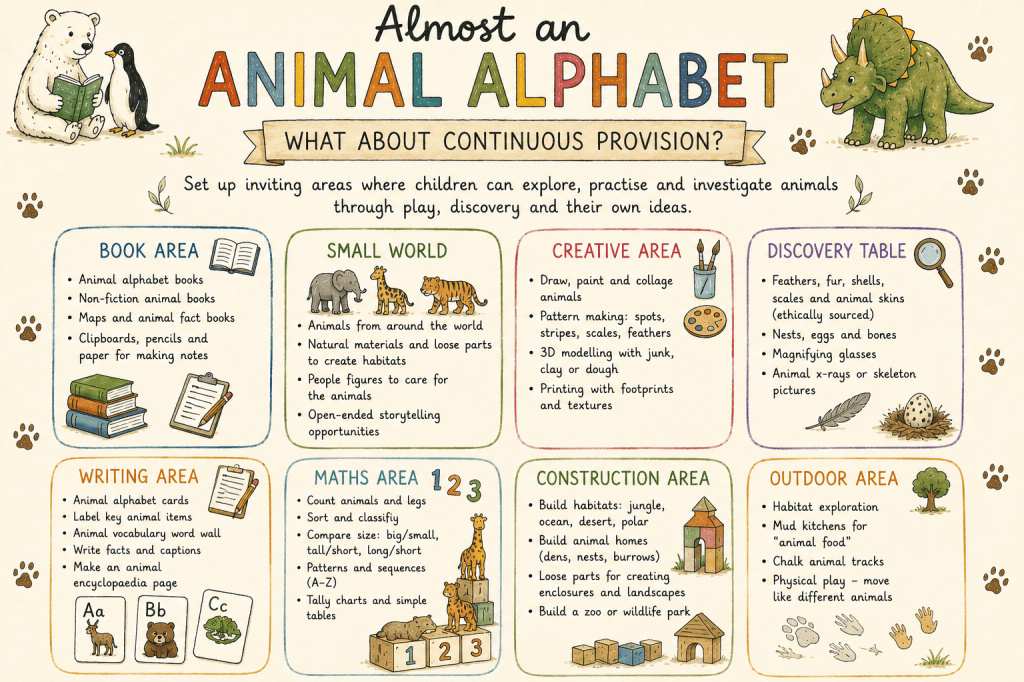
What about Continuous Provision?
What About Continuous Provision?
Almost an Animal Alphabet is particularly easy to weave into continuous provision. Rather than creating lots of separate adult-led activities, add a few carefully chosen resources to the areas children already use and allow the ideas from the book to continue through their play.
Book Area
Add Almost an Animal Alphabet alongside animal encyclopaedias, non-fiction books, atlases and other alphabet books. Include maps, clipboards, pencils and paper so children can follow their own interests, copy animal names or record something they have discovered.
Small World
Provide a mixed collection of animal figures rather than arranging them into predetermined groups. Add natural materials and loose parts so children can create their own habitats, enclosures and stories. Their choices can lead naturally into conversations about where animals live, what they eat and which animals might live together.
Creative Area
Offer paints, collage materials, dough, clay and junk modelling alongside pictures of different animals. Encourage children to look closely at spots, stripes, scales, feathers, shapes and textures rather than providing a finished model to copy. Toy animals can also be used to investigate footprints and printing.
Discovery Table
Feathers, shells, replica bones, nests, eggs, animal skins or fur samples can encourage close observation and questioning. Where real natural materials are used, make sure they are safe and ethically sourced. Add magnifying glasses and photographs of skeletons, footprints or animal features for children to investigate.
Writing Area
Add animal alphabet cards, photographs, interesting writing materials and simple word banks. Children might label an animal, make a list, write a caption, create their own A–Z or record an interesting fact they have discovered.
Don’t make every piece of writing an adult-set task — sometimes a child independently deciding that their tiger enclosure needs a “DANGER” sign is exactly the meaningful writing we’re looking for.
Maths Area
Animal figures are perfect for open-ended sorting and counting. Children can group them by their own criteria, count legs, compare sizes and create repeating patterns. Add hoops, sorting trays, number cards, rulers and simple tally materials and see what the children choose to do with them.
Construction Area
Challenge children to build somewhere for an animal to live. It might be a den, nest, zoo enclosure, wildlife park or an entire habitat. Blocks and loose parts encourage children to think about space, size, structure and purpose as they build.
Outdoor Area
Take the animals outside. Make tracks with chalk, create habitats from natural materials, make animal food in the mud kitchen or move around the space in different ways — crawling, hopping, prowling, stretching or stomping.
You could also go on an animal alphabet hunt. Which animals can we actually find in our outdoor environment? A for ant, B for bird, C for…?
Keep It Child-Led
You don’t need to enhance every area at once. Choose the provision that fits your children, introduce a few interesting resources and then watch what happens.
The most useful next step may come from their question rather than our planning. If a child suddenly wants to know why a penguin can’t fly, where a tiger sleeps or whether a snail has teeth, you’ve got your next piece of learning right there.
Claire’s Final Thoughts
Almost an Animal Alphabet lends itself particularly well to the start of a new term, especially with a newly formed or blended class. The familiar world of animals gives children an accessible way into exploring initial letters and sounds, while activities such as creating Our Class Alphabet can help children learn one another’s names and begin to feel part of their new class.
What I particularly like about this book is its flexibility. At its simplest, children can name the animals, listen for their initial sounds, count legs or simply talk about what they can see. For older or more confident children, those same animals can become the starting point for classification, habitats, geography, alphabetical order, research and non-fiction writing.
That makes it particularly useful for mixed-age classes or groups with a wide range of abilities. Everyone can begin with the same book and share the same starting point, but the learning doesn’t have to look the same for every child. Activities can be simplified, extended or followed in completely different directions depending on children’s interests and needs.
And perhaps that’s the real strength of Almost an Animal Alphabet. It looks like a simple alphabet book, but with the right questions and opportunities, A to Z can take us almost anywhere — and far beyond the story shelf.


Leave a comment